
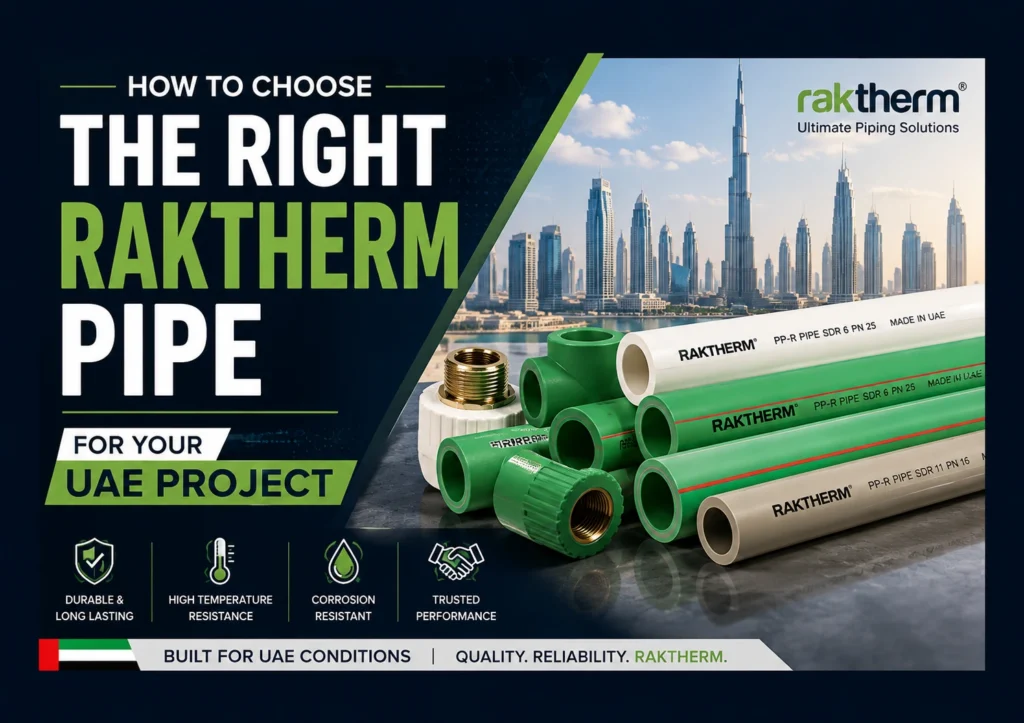
Most pipe selection in the UAE happens in about four minutes. Someone opens the last project’s schedule, swaps the diameters, and sends it up for approval. Then July arrives, the roof tank sits in 48°C ambient, and the “cold” water line is carrying water hotter than most European hot lines ever see.
That’s the part missing from almost every guide on how to choose Raktherm pipes: the pressure rating stamped on the pipe is measured at 20°C, and very little in a UAE building ever sits at 20°C. Get the material and class right and the system quietly outlives the building’s first refurbishment. Get it wrong and you find out in year three, behind a wall, in an occupied unit.
Why Pipe Selection Matters in UAE Projects
Piping is a small line on the MEP budget and an enormous line on the remedial one. Chasing out a failed concealed hot water run in a finished villa costs several times what the pipe cost, before anyone counts the tenant’s temper.
The Gulf adds three pressures that European specs quietly assume away. Ambient heat in ceiling voids, shafts and roof runs pushes standing water well past design assumptions in summer. Direct UV on exposed rooftop lines degrades unprotected polymer over years, not decades. And UAE soil conditions — sandy, saline, shifting under fill — punish rigid buried systems that were selected purely on price per metre.
None of that shows up in a pipe schedule. It shows up in year three.
Understanding Raktherm PPR, PEX and uPVC Systems
Raktherm is manufactured in Ras Al Khaimah by Tahweel, out of a 40,000 m² plant, with PP-R and PE-X produced to the German DIN 8077/8078 framework. The company publishes a 15-year guarantee on its piping network components, which matters less as a marketing line and more as a signal of what the manufacturer expects the system to survive.
Here’s the practical map:
| System | Typical use | Temperature ceiling | Joint method |
|---|---|---|---|
| PPR (PP-R) | Hot and cold potable water, risers, concealed runs | ~70°C continuous, short peaks near 95°C | Heat fusion welding (~260°C) |
| PPR fibre / aluminium composite | Exposed, long or high-temperature runs | Same as PPR, with far less linear expansion | Heat fusion, faced or peeled first |
| PEX (PE-X) | Underfloor heating, manifold loops, tight retrofits | Comparable hot-water service, flexible | Mechanical / press fittings |
| uPVC pressure | Cold water mains, irrigation, industrial cold transfer | Below 40°C | Solvent cement or rubber ring |
| uPVC drainage | Soil, waste and underground drainage | Ambient only | Solvent cement or push-fit |
If you’re specifying more than one of these on the same project, source them from a single Raktherm pipes and fittings supplier in UAE so dimensional compatibility and certification paperwork stay consistent across the whole system.
When Should You Choose PPR?
PPR is the default for potable hot and cold water in UAE buildings, and it deserves to be. It doesn’t corrode, doesn’t scale, doesn’t flavour desalinated water, and a heat-fused joint becomes a single continuous piece of material rather than a mechanical connection waiting to relax.
The real decision inside PPR is not whether, it’s which class and which construction. PN20 handles standard hot and cold distribution in villas and low-rise. PN25 carries the thicker wall you want for high-rise risers, plant room headers, and anywhere static head stacks up on top of pump pressure. Same outside diameter, different wall thickness, different service life under load.
Then there’s the part contractors skip: plain PPR expands noticeably along its length when heated, which is why a long straight hot run pinned rigidly to a wall will bow and stress its joints. Fibre-reinforced and aluminium-composite Raktherm lines exist precisely to cut that movement down. For anything exposed to direct sunlight, specify the UV-protected construction rather than hoping paint or lagging will hold up through a Dubai August.
My honest opinion after reading enough failure post-mortems: the pipe is rarely what fails. The fusion joint made with an uncalibrated welder by someone working fast in 45°C heat is what fails.
When Is PEX More Suitable?
PEX earns its place where PPR is awkward. It bends around obstacles, runs continuously from a manifold to a fixture with no joints buried in between, and installs quickly in retrofits where you can’t open every wall.
Underfloor heating and loop-based villa distribution are its strongest cases. Fewer concealed joints means fewer concealed failure points, which is a genuinely different risk profile from a fused tree of tees.
The trade-offs are real. Fittings cost more per connection than fused PPR, the tooling is specific, and PEX must be fully protected from UV — it is not an exposed rooftop material under any circumstances. If cost is what’s driving the comparison, check current Raktherm PEX pipe price in UAE against the fused alternative on a per-connection basis, not per metre. Per metre flatters PPR. Per connection tells the truth.
Where Does uPVC Make Sense?
uPVC has two clean jobs, and neither of them involves hot water.
Drainage is the obvious one. Raktherm’s underground range is produced to BS EN 1401 with heavier walls for soil loading, in the familiar orange, across 110mm to 315mm with rubber-ring push-fit joints that tolerate slight misalignment. Above ground it handles soil and waste. Install horizontal runs at roughly 1:40 to 1:80 fall — flatter and solids settle, steeper and the water outruns them.
The second job is cold pressure: mains, irrigation, industrial cold transfer, in PN6, PN10 and PN16 classes below 40°C. Note that ceiling. A uPVC line that a plumber later cross-connects to a hot supply is a callback with a date on it. Sourcing through an authorized distributor of Raktherm uPVC pipes also gets you the EN certification documents that Dubai Municipality submissions tend to ask for.
How Temperature and Pressure Affect Pipe Selection
This is where most selection errors originate, so it’s worth being precise.
A PN rating is the allowable continuous working pressure at 20°C over a 50-year design life. Not at 60°C. Not on a roof in August. Every part of ISO 15874, the international standard governing PP piping for hot and cold water, is built around application classes that pair a design temperature with a design pressure. The two numbers only mean something together.
PPR holds roughly 70°C continuously with short peaks near 95°C, but its pressure capacity falls off substantially as temperature climbs. So a PN20 pipe is not a 20-bar pipe in a hot riser. It’s a 20-bar pipe in a laboratory.
A worked example, illustrative rather than from a specific project: take a mid-rise tower where pump discharge sits at 6 bar and the lowest floors carry another 3 bar of static head. On a cold line at genuine cold temperature, PN20 has comfortable margin. Put that same 9 bar into a 60°C hot water riser and the margin narrows fast, which is exactly why consultants specify PN25 on hot risers and leave PN20 for branch distribution. Read the manufacturer’s derating table, not the print on the pipe.
The UAE twist is that “cold” is a category, not a temperature. Rooftop tanks and unshaded lines can deliver water in the 45–55°C range for weeks in summer. Design the cold line for what it will actually carry.
Choosing Pipes for Villas vs Commercial Buildings
The material is often the same. The engineering is not.
For a villa, the whole system usually sits inside one pressure zone. PPR PN20 for general distribution, PN25 where hot runs are long or the pump is aggressive, uPVC below ground for drainage, PEX where underfloor heating or a difficult retrofit route makes it worth the fittings cost. One pipe schedule covers the building.
For commercial buildings, static head does the deciding. A tower’s lower floors see pressure a villa never approaches, so hot risers move to PN25 and pressure-reducing valves zone the building vertically. Expansion becomes a design item rather than an afterthought — composite pipe, proper support spacing, and expansion loops or arms on long vertical runs. Fire performance, access for maintenance, and diameter availability across the range all start constraining the choice. And on commercial plumbing projects in the UAE, the approved consultant specification outranks every rule of thumb in this article, including mine.
Common Pipe Selection Mistakes
- Reading PN as the pipe’s real-world pressure limit. It’s a 20°C figure. In a hot riser the usable number is meaningfully lower, and this single misunderstanding causes more premature failures than any material defect.
- Treating cold water lines as cold. See the temperature section. UAE summer makes “cold” a polite fiction on rooftop and unshaded runs.
- Plain PPR exposed to direct sun. Specify the UV-protected or composite construction, or expect degradation on the runs nobody inspects.
- Mixing brands across pipe and fittings because a size was out of stock that week. Dimensional tolerances differ between manufacturers, and fusion assumes they don’t.
- Uncalibrated fusion tools and rushed joint times. Fusion welding runs near 260°C with defined heating and cooling windows. Rush it and you get a joint that passes the pressure test and fails in month eighteen.
- Under-supporting horizontal hot runs. Follow the manufacturer’s support spacing per diameter and class. Unsupported hot PPR sags, and every sag transfers load into a joint.
Raktherm Pipe Selection Checklist
Run this before the order goes out.
- Confirm the actual design temperature for each line, hot and cold, in UAE summer conditions.
- Add pump pressure to static head at the lowest point served, then compare against the derated capacity at that temperature.
- Assign the pressure class per line: generally PN20 for distribution, PN25 for hot risers and headers.
- Flag every exposed or rooftop run and switch it to a UV-protected or composite construction.
- Verify uPVC pressure lines stay below 40°C for their whole service life, including future cross-connections.
- Check support spacing and expansion provision against the current Raktherm technical catalogue for the exact diameter and class.
- Request the DIN/EN/ISO certification documents at quotation stage, not after delivery. A supplier who hesitates is telling you something.
Frequently Asked Questions
Q: How do I choose the right Raktherm pipe for my project? A: Start with the real service temperature, not the design assumption, then add pump pressure to static head at the lowest point served. That pair decides material and class. Knowing how to choose Raktherm pipes for UAE projects is mostly matching class to actual conditions, then protecting whatever sits in the sun.
Q: Which Raktherm pipe is best for hot water in the UAE? A: Raktherm PPR pipes are the standard choice, rated for roughly 70°C continuous service with short peaks near 95°C. Use PN20 for typical branch distribution and PN25 for hot risers, plant room headers, and any line where high temperature and high static head stack up together.
Q: Can Raktherm uPVC pipes be used for hot water? A: No. Raktherm uPVC pipes in the pressure range are specified for cold applications below 40°C: mains, irrigation, industrial cold transfer. Hot water needs PPR or PEX. Run uPVC hot and you get softening, deformation, and joint failure well before design life.
Q: What is the difference between PN20 and PN25 Raktherm PPR pipes? A: Both share the same outside diameter, but PN25 carries a thicker wall and a higher allowable working pressure at the 20°C reference temperature. PN25 belongs on hot risers in multi-storey buildings, where temperature and static head stack. PN20 handles ordinary branch distribution.
Q: Does Raktherm PPR need UV protection outdoors in the UAE? A: Yes, for anything exposed. Standard PPR degrades under sustained direct sunlight, so specify the UV-protected or aluminium-composite Raktherm PPR pipes for rooftop and external runs. Shielding added later rarely survives multiple UAE summers, and unwatched runs are exactly the ones that fail.
Q: What should I check before ordering pipes for a UAE commercial project? A: Confirm the pressure class per line, the UV protection on exposed runs, and the DIN/EN/ISO certificates at quotation stage. For plumbing pipes on commercial projects in the UAE, the approved consultant specification overrides every general rule, including the ones in this article.
Before You Release the Order
Take your pipe schedule and mark the temperature each line will genuinely carry in August, not in the design assumption. That one pass usually reclassifies two or three lines and catches the expensive mistakes while they’re still on paper.
Knowing how to choose Raktherm pipes is mostly this: match class to real conditions, protect what sits in the sun, and buy pipe and fittings from one certified source so the system stays a system. Do that, and the cheapest part of your MEP package stops being the part that comes back.