
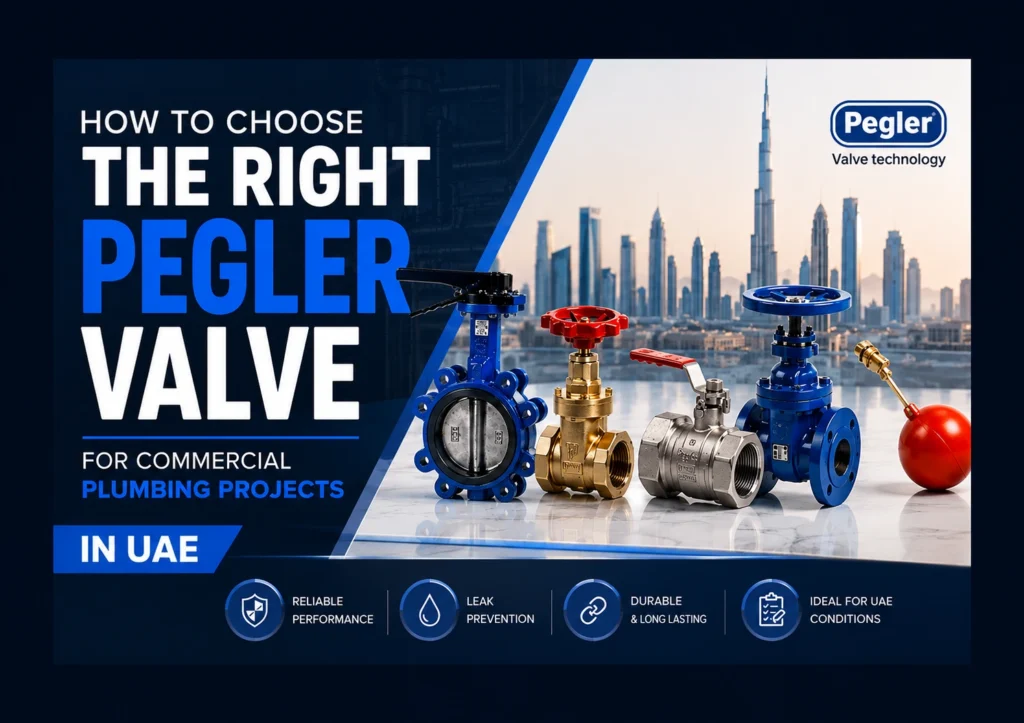
A valve that passes inspection can still be the wrong valve. It holds pressure on the day, gets signed off, and then starts weeping at the stem fourteen months later, after the ceiling is closed and the tenant has moved in.
Very few of those are manufacturing faults. They are selection faults, decided months earlier by someone comparing two line items on a quotation.
Knowing How to Choose the Right Pegler Valve properly comes down to a fixed order: duty first, then the medium and the water it will actually sit in, then the pressure and temperature envelope, and only after that, size and connection. Price is the last filter, not the first.
The sequence is below, along with the UAE-specific part that almost every valve selection guide leaves out.
Start With Duty, Not With Size
Every valve on a commercial system is doing one of three jobs, and mixing them up causes most of the trouble.
Isolation means fully open or fully shut, nothing in between. Ball valves and gate valves live here. Regulation means holding a set flow or throttling it, which is globe valve and commissioning valve territory. Protection means the valve is there to stop something bad happening: a check valve preventing backflow, a pressure reducing valve protecting downstream fittings, a strainer keeping debris out of a pump.
Use a gate valve to throttle flow and the disc will chatter against the seat until it no longer seals. It will still open and close. It just will not shut off tightly, which you discover on the day you actually need it to.
Ball valves fail the opposite way. They are excellent isolators and poor regulators, because nearly all the flow change happens in a narrow band of the quarter turn. Contractors use them for balancing anyway because they are cheap and already on site. That decision usually resurfaces at commissioning.
Pegler Valve Types and What Each One Is Actually For
According to Pegler’s own threaded general valve range, quarter turn ball valves sit alongside gate, globe, check, Y-strainers, drain cocks and pressure reducing valves. Most commercial requirements can be met from one supplier without mixing brands across a system.
| Valve type | What it does | Reach for it when | Leave it alone when |
|---|---|---|---|
| Ball valve | Quarter turn, full shut-off | Riser isolation, branch isolation, plant room take-offs | You need to set a flow rate |
| Gate valve | Straight-through, low pressure drop | Large bore mains, rarely operated isolation | The valve will be partly open for long periods |
| Globe valve | Throttles and regulates | Flow control, applications with frequent adjustment | Pressure drop is critical |
| Check valve | Prevents reverse flow | Pump discharge, tank fill lines, riser bases | Flow is genuinely bidirectional |
| Y-strainer | Catches debris | Upstream of pumps, PRVs, control valves | There’s no access to clean the screen |
| PRV | Drops and stabilises downstream pressure | High-rise zones, incoming mains | Downstream demand swings wildly with no accumulator |
One thing worth stating plainly: Pegler’s ball valve range extends beyond traditional threaded, compression and flanged ends into press fit and push fit connections, which matters more on refurbishment work than on new build, where hot works permits are the real programme risk.
The UAE Part Everyone Skips: Water Chemistry and Heat
This is where a generic selection guide stops being useful.
Standard brass is vulnerable to dezincification, an electrochemical process where zinc leaches out of the alloy and leaves behind a porous, weak copper structure. The valve looks fine from outside. Then the body or stem starts leaking, or a chalky white deposit appears around the joint.
The conditions that trigger it read like a description of a Gulf plumbing system. High chloride content, high water temperatures above 70°C and low bicarbonate levels all accelerate dezincification, and stagnant water in unused lines makes it worse. UAE supply is largely desalinated and blended, hot water services run high, and half-let towers and seasonally occupied villas leave water sitting in branches for weeks.
The answer is dezincification-resistant brass.
What DZR brass is: a brass alloy formulated to resist zinc leaching, either by adding small quantities of arsenic (up to around 0.15%) or by keeping zinc content below 15%.
Compliance is not a marketing claim, it is a test. ISO 6509 exposes a polished sample to copper chloride solution at 75°C for 24 hours, and the measured dezincification depth must not exceed 200 microns. Ask for the certificate. A supplier who can produce one on request is telling you something about the rest of their stock.
Pegler offers commercial ball valves in unplated DZR brass as well as standard and chrome plated brass, so this decision is available to you at order stage rather than after handover.
If one line item deserves defending in a value engineering meeting, it is this one. The price gap between standard and DZR brass on a mid-size project is small. The cost of chasing leaks through a finished ceiling is not.
Sizing, Connection and the Part That Bites at Commissioning
Line size is not valve size. A 50mm pipe does not automatically want a 50mm valve, and a full bore valve and a reduced bore valve of the same nominal size behave very differently at the flow rates you designed for. Check the Kv figure, not the label on the box.
Then check the thread standard, which is where imported goods on UAE sites regularly go wrong. Most Pegler valve ranges are offered in three thread options: BS21 taper, ISO 228 parallel and ANSI NPT. A parallel thread mated to a taper fitting will seal with enough PTFE and optimism. For about a year.
Pressure rating deserves the same attention. Pegler DZR compression ball valves are rated PN16 with ends to EN 1254/2, which is comfortable for most domestic water systems and not automatically enough for a tall riser under static head plus pump pressure. Work out the worst case, not the running case.
For potable water, confirm approval status rather than assuming it. Pegler states WRAS approval where valves are suitable for drinking water, and approvals are product-specific, not brand-wide.
Different Projects, Different Answers
Villa or low-rise residential. Pressure is modest, but stagnation is common in guest wings and irrigation lines. DZR brass earns its money here.
Hotel. Continuous recirculating hot water at high temperature, plus almost no tolerance for shutting a floor down. Specify for isolation granularity, not just for the riser.
Office tower. Static head is the constraint. Zone the building, size PRVs for the pressure break, and make sure every isolation valve is reachable without cutting a ceiling.
Chilled water and HVAC. Different temperature range entirely, and condensation and insulation detailing around the valve body matter as much as the valve. Commissioning valves belong in the design, not added later.
Five Mistakes That Cost the Most
- Specifying standard brass on a hot water recirculation loop because the datasheet did not mention water chemistry.
- Using ball valves for balancing, then discovering at commissioning that flow rates cannot be set repeatably.
- Ordering by nominal size without checking whether the valve is full bore or reduced bore.
- Mixing thread standards across a package because two suppliers were used.
- Installing valves above fixed ceilings with no access panel. The valve is fine. Reaching it costs a day and a ceiling contractor.
What to Put on the Submittal
| Check | Why it matters | What to write |
|---|---|---|
| Duty | Determines valve type before anything else | Isolation / regulation / protection |
| Material | Dezincification risk in UAE water | DZR brass, ISO 6509 |
| Pressure | Static head plus pump, not running pressure | PN rating |
| Temperature | Hot water and chilled water differ | Max operating °C |
| Thread standard | Prevents cross-package mismatch | BS21 / ISO 228 / NPT |
| Bore | Affects actual flow | Full bore or reduced bore |
| Approval | Potable water compliance | WRAS, product reference |
| Access | Maintenance over 20 years | Access panel location |
Frequently Asked Questions
How do I choose the correct Pegler valve size? Size on flow and pressure drop, not on pipe diameter. Check the valve’s Kv value against your design flow rate, then confirm whether the valve is full bore or reduced bore. A reduced bore valve at nominal line size can restrict flow more than expected.
What is the difference between a ball valve and a gate valve? Both isolate. A ball valve operates with a quarter turn and seals tightly, making it suited to frequently operated isolation points. A gate valve opens fully for very low pressure drop and suits large bore mains that are rarely operated. Neither should be used for throttling.
Are Pegler valves suitable for commercial plumbing in the UAE? Yes, provided the correct variant is specified. Knowing How to Choose the Right Pegler Valve for local conditions matters more than the brand decision itself: the commercial range covers ball, gate, globe, check, strainer and pressure reducing valves in several materials and connection types, and the choice that counts is DZR brass versus standard brass.
Why does DZR brass matter here specifically? UAE supply is largely desalinated and blended, hot water services run hot, and stagnation is common in partly occupied buildings. Those conditions accelerate dezincification in standard brass. DZR resists it, verified by ISO 6509 testing.
How does pressure rating affect valve selection? Rate for the worst case, combining static head with pump pressure and any surge. A PN16 valve is adequate for most low-rise systems and marginal on tall risers. Under-rating shows up as stem leaks and seat damage rather than sudden failure.
Where can contractors source Pegler valves in the UAE? Through an authorised channel, so that material certification, approval documentation and warranty support come with the goods. See our guide to working with an authorized Pegler distributor in UAE.
Before You Release the PO
Take the valve schedule you already have and add three columns: duty, material, and thread standard. Most schedules list size and type only, which is exactly why substitutions slip through at procurement.
If any line comes back blank on material, that is the line to fix first. Choosing Pegler valves well is mostly a documentation habit, not a technical mystery. The valve rarely fails. The specification does.
As an authorized Pegler distributor in UAE, Junaid World supplies these ranges with the material certificates and approval documents attached to the delivery, not chased down six months later when a consultant asks for them.