
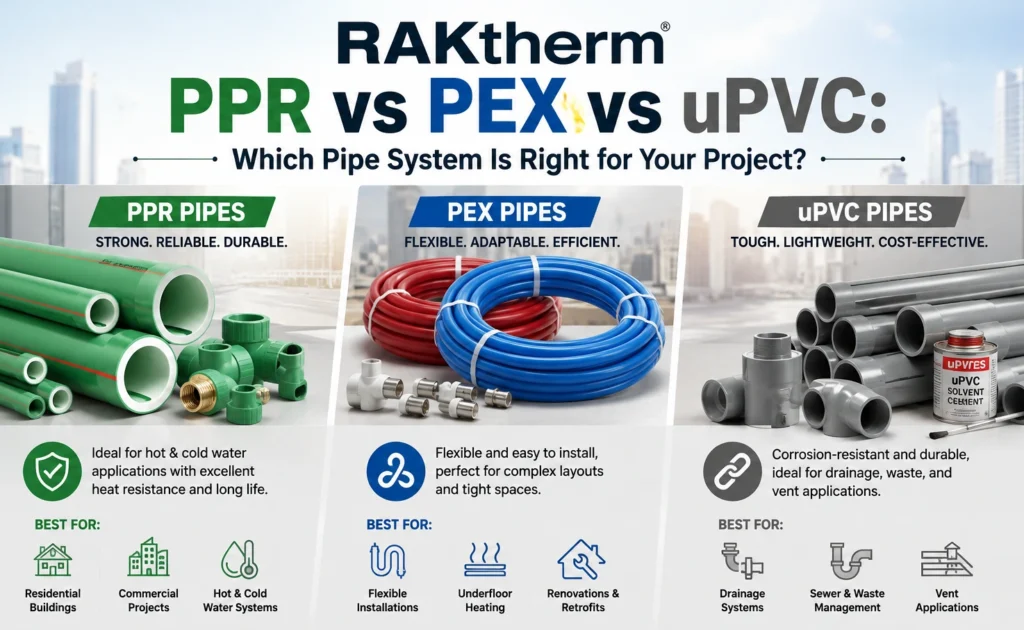
Three materials, one building, and a spec sheet that quietly treats them as interchangeable. They aren’t. On a standard UAE villa you will most likely install all three anyway: RAKtherm PPR on the hot and cold water, PEX where the pipe has to bend around something awkward, uPVC carrying waste down to the sewer connection. So the honest version of the Raktherm PPR vs PEX vs uPVC question isn’t “which one wins.” It’s “which one belongs on this particular line.”
Choose by material and the submittal looks fine. Choose by where the pipe physically sits (rooftop, buried, chased into a block wall, exposed in a plant room at 48°C) and you avoid the failures that surface in year three, long after the contractor has demobilised.
RAKtherm PPR vs PEX vs uPVC at a Glance
| RAKtherm PPR | RAKtherm PEX | RAKtherm PVC-U (uPVC) | |
|---|---|---|---|
| Main job | Pressurised hot and cold potable water | Pressurised water where flexibility helps | Drainage, waste, vent, sewerage |
| Joint method | Heat fusion welding (becomes one piece) | Mechanical fittings / manifold system | Solvent cement or push-fit rubber seal |
| Temperature | 0–90°C continuous, 100°C short peaks | Handles heat well; stays flexible cold | Push-fit joints rated to around 70°C |
| Design life | 50 years per DIN 8077/8078 | Long, when correctly supported | Long, non-pressure service |
| Weak spot | Linear expansion; UV if unprotected | Fitting quality and support spacing | Not a hot water pressure pipe |
| Typical UAE use | Villa and tower water risers, chilled water | Underfloor loops, tight retrofits, branch runs | Soil stacks, waste, below-slab drainage |
One naming note before anyone gets confused reading a submittal: RAKtherm writes it as PVC-U, most of the market says uPVC, and it is the same unplasticised polyvinyl chloride. Different word order, same pipe.
1. RAKtherm PPR: A Strong Choice for Hot & Cold Water
PPR is the default for a reason, and the reason is the joint.
Fusion welding doesn’t clamp two components together. It melts them into a single continuous piece of polypropylene, so there’s no gasket to perish, no thread to weep, no compression ring slowly relaxing behind a plasterboard access panel. RAKtherm manufactures its PPR systems to the German standard DIN 8077/8078, rated for continuous service between 0°C and 90°C with short-term peaks up to 100°C and a 50-year design life. That covers domestic hot water, chilled water networks, and heating loops without drama.
It is also non-corroding, chemically stable, and light enough that a crew can carry a full day’s material up a stairwell without a hoist. Food and medical facilities use it for exactly those hygiene reasons.
Where plain PPR gets you into trouble is heat movement and sunlight. Polypropylene expands roughly 0.15 mm per metre for every degree of temperature rise. Run 6 metres of it, put 50°C of swing through it, and you have around 45 mm of movement to absorb somewhere. Hidden in a chase with a proper expansion loop and correct bracket spacing, that’s a non-issue. Clamped rigid at both ends by someone in a hurry, it becomes a sagging line and a stressed weld.
That’s what the reinforced RAKtherm variants exist to solve. The glass-fibre RRF system cuts linear expansion by up to 70%. The aluminium Reinforced Stabi UV (RRSV) system claims about a 75% reduction plus roughly 20% higher flow rate, and its black outer layer is built for open-air installation. For anything exposed to direct UAE sun, use the anti-UV range, rated 5°C to 95°C over a 50-year service life. Plain white PPR baking on a rooftop is not a value engineering decision. It’s a warranty problem.
2. RAKtherm PEX: When Flexibility Matters
PEX is crosslinked polyethylene: the polymer chains are chemically bonded together so the material stops softening under heat and load, which improves stress crack resistance and toughness considerably over standard PE.
The practical value is that it bends. A PEX line can be pulled continuously from a manifold to a fixture with no joints in between, and a joint you never made is a joint that can never leak. On retrofits inside occupied villas, that single property saves more chasing and making good than any spec sheet captures. It also shrugs off freezing better than rigid pipe, which matters less here and matters a lot to anyone specifying for export or for cold rooms.
Two things to settle before you commit. First, PEX depends entirely on its fittings, so ask which jointing system is being supplied and confirm it’s the manufacturer’s own. Second, flexible pipe needs closer support spacing than rigid pipe; skip that and you get sagging runs that trap air and rattle.
Budget is the other question everyone asks and nobody answers straight. PEX pipe and its fittings typically sit above PPR per metre in this market, then claw part of that back in labour because you’re making far fewer joints. Whether it nets out cheaper depends on your layout, not on the material. Price it properly before you decide: check the current Raktherm PEX pipe price in UAE against a PPR take-off for the same run, including fittings and welding time, and let the two numbers argue it out.
My honest read: on new-build UAE projects with straight vertical risers and generous shafts, PPR usually wins on cost and on the strength of the welded joint. PEX earns its place on underfloor loops, manifold-fed apartment layouts, and any refurbishment where you’re threading pipe through a building you’re not allowed to demolish.
3. RAKtherm uPVC: Where PVC-U Systems Make Sense
Here’s the part most three-way comparison articles get wrong.
RAKtherm’s Multi-Layer Reinforced PVC-U range is a drainage, waste and vent system. It is not a hot-water pressure system, and it isn’t trying to be. Comparing it head-to-head with PPR for a hot water riser is like comparing a truck with a boat because both move cargo.
The range is organised by colour and by where the pipe goes. White is the Enhanced system for underground and aboveground, solvent jointed. Grey is the Intensified aboveground system, available solvent jointed or push-fit. Terracotta orange is the Heightened underground system, again in both jointing methods. The push-fit versions use a multi-layer reinforced rubber joint that withstands up to 70°C, which is what you want when a kitchen dumps near-boiling water into a waste stack.
Two details in this range are worth more than the marketing around them. The pipes are built in three layers with a cellular middle layer, and the resulting acoustic performance is tested against EN 14366 and the German standard DIN 4109. If you have ever lived in a tower where you can hear the neighbour’s WC through the wall at 2am, you already understand why an acoustic drainage spec is worth arguing for at tender stage. The second is the triple-sealing-lip DIN lock seal, which is designed to hold a seal across a wide range of joint tolerances at low assembly force. Translation: it tolerates the real world, where nobody’s cuts are perfectly square.
Sourcing matters more here than on the supply side, because the colour, the jointing method, the seals and the solvent cement all have to belong to the same family. Buy the pipe from one merchant and the cement from whoever had stock and you have quietly designed your own hybrid system. Go through an authorized distributor of Raktherm uPVC pipes so the whole drainage run arrives as one matched set. And check your sizing and gradients against Dubai Municipality’s sewerage design guidelines, which set out recommended pipe materials, minimum cover depths and flow assumptions for Dubai.
PPR vs PEX vs uPVC: What Is the Real Difference?
Strip out the brochure language and three things separate them.
How the joint is made. PPR is fused into one continuous material. PEX is mechanically connected. uPVC is solvent welded or sealed with a rubber gasket. That single difference drives the failure mode of each system, the skill level you need on site, and how repairable it is at 11pm on a Friday.
What pressure and temperature it holds. PPR handles hot water under pressure for 50 years. PEX handles hot water under pressure and moves while doing it. uPVC drainage handles gravity flow with hot discharge, not sustained pressure.
How much it moves. PPR expands the most and has the most engineering built around solving that (fibre core, aluminium layer, expansion loops). uPVC moves less. PEX moves, but its flexibility absorbs it, provided the supports are right.
Everything else in the PPR vs PEX vs uPVC debate is downstream of those three.
PPR vs PEX vs uPVC for UAE Projects
The Gulf changes the ranking, and not by a small margin.
Rooftop surface temperatures here regularly pass 70°C, and uninsulated rooftop tanks are commonly reported sitting at 50–60°C internally from June through September, which is why guidelines push for cold storage below 25°C. Add a national record of 51.6°C ambient. The practical consequences for pipe selection:
- The “cold” water line is not cold. Anything you specify for cold water needs to be comfortable at temperatures a European project would call hot. PPR at 0–90°C continuous absorbs that without complaint. It is one of the strongest arguments for PPR over cheaper cold-water-only materials in this region.
- Exposed runs need UV protection, not paint. Site-applied paint chalks off and fails. Anti-UV or Reinforced Stabi UV pipe carries protection in the material itself.
- Expansion is a summer problem, not an average problem. Design for the July delta, not the annual mean. This is where the fibre-reinforced and aluminium-reinforced systems pay for themselves.
- Ground and buried services see chlorides and salt-laden groundwater in coastal zones. Plastic doesn’t corrode. Nothing more needs saying.
- Acoustic drainage is a genuine differentiator in residential towers. Handover complaints about pipe noise are expensive and almost impossible to fix retroactively.
What Should You Check Before Selecting a Pipe?
Ask these five before the material is ordered, not after.
Where does this line physically sit? Buried, chased, exposed to sun, inside a shaft, above a ceiling. This answer usually decides the material on its own.
What temperature will it actually see in August? Not the design brief number. The real one.
Who is welding it, and are they certified? PPR is genuinely simple to weld and genuinely easy to ruin: wrong temperature, wrong dwell time, or a dirty socket produces a joint that passes pressure test and fails eighteen months later. RAKtherm runs a training academy and publishes its own welding, pressure test and linear expansion guidelines. Someone on the crew should have read them, and if nobody has, that’s your first site instruction.
Are the fittings, valves and solvent cement from the same manufacturer? See the section below.
What does the consultant’s specification and the local authority actually approve? Dubai Municipality, DEWA, Abu Dhabi DM and the northern emirates each keep their own approved-materials lists, and they do get updated. One example worth knowing: since late 2022, DEWA has required drinking water system components to carry NSF/ANSI/CAN 61 certification for new tenders and developer projects in Dubai, which pulls pipes, fittings, seals and jointing materials into scope. Ask your supplier for the certificate, not the claim. Confirm current approval for your emirate and building type before you buy, because this is one of the few places where I’d tell you not to trust a blog post, including this one.
Common Pipe Selection Mistakes
- Specifying plain PPR for a rooftop or exposed run. UV degradation and unmanaged expansion, usually visible within two or three summers.
- Rigidly clamping a long hot line at both ends. Removing the expansion allowance doesn’t remove the expansion. It just moves the stress into the welds and the fittings.
- Mixing brands mid-system because a size was out of stock. Wall thicknesses, socket depths and material formulations vary between manufacturers. The joint is where the system fails and that’s exactly what you’ve compromised.
- Using generic solvent cement on uPVC. RAKtherm manufactures cement to match its own PVC-U compound. Cheaper cement is the most expensive saving on the job.
- Treating drainage as an afterthought. Undersized stacks, poor venting and non-acoustic pipe in a residential tower create complaints you cannot resolve after handover without opening walls.
- Buying on price per metre. Pipe is a small fraction of the installed cost. Labour, rework and access are the rest, and a leak inside a finished wall costs multiples of the entire pipe order.
Why the Complete System Matters
A piping system is not a pipe. It’s pipe, fittings, valves, seals, solvent cement, brackets and the welding procedure, all designed to behave as one thing.
RAKtherm’s approach across its ranges reflects that: PPR fittings formulated from the same resin as the pipe, anti-UV fittings developed specifically so an outdoor line isn’t UV-protected pipe joined by unprotected fittings, and solvent cement made to match its own PVC-U compound. This is also why they built out adjacent systems (reinforced stabi, fire-resistant PPR, PE gas pipe, HDPE infrastructure, RAKduct electrical conduit) rather than only selling pipe.
The failure mode of a mixed system is always the same and always in the same place. Nobody’s pipe splits in the middle. It fails at the joint, which is precisely where two manufacturers’ tolerances meet.
Which makes procurement a technical decision, not a purchasing one. Ordering pipe, fittings, valves and cement together from a single Raktherm pipes and fittings supplier in UAE costs nothing extra and removes the most common cause of substitution: a size goes out of stock mid-job, the foreman needs it today, and something almost-identical gets welded into your riser.
So, Which RAKtherm System Should You Choose?
Decide line by line.
Hot and cold potable water, chilled water, heating: PPR, moving to the fibre or aluminium reinforced version wherever expansion or long runs are in play, and the anti-UV version anywhere sunlight reaches it.
Underfloor heating loops, manifold layouts, retrofits inside finished buildings, anywhere the pipe has to curve around structure: PEX.
Soil, waste, vent, sewerage, below-slab and buried drainage: PVC-U, white for underground and above, grey for aboveground, terracotta orange for underground, push-fit where the discharge runs hot or where you want acoustic performance in a residential building.
Most projects use two of these. Many use all three. That is the correct outcome, not a compromise.
Frequently Asked Questions
Is PPR or PEX better for hot water? Both handle hot water well. PPR’s fusion-welded joints make it the stronger choice for main risers and long straight runs, with a 50-year design life to DIN 8077/8078. PEX is better where the pipe must bend, on underfloor loops, and in retrofits where you want fewer joints inside finished walls.
Can uPVC be used for hot water supply? No. RAKtherm’s PVC-U range is engineered for drainage, waste, vent and sewerage, not pressurised hot water. Its push-fit joints tolerate discharge up to around 70°C, which is a different requirement from continuous pressurised hot water service. Use PPR or PEX for supply.
Which pipe is best for UAE weather? For water supply in exposed conditions, PPR with anti-UV or Reinforced Stabi UV protection, rated 5°C to 95°C over a 50-year service life. Rooftop surfaces here exceed 70°C, so UV resistance and controlled linear expansion matter more than the base material choice.
What is the difference between PPR and PPRC? None, in practice. PPRC is a common regional shorthand for polypropylene random copolymer, the same material sold as PPR or PP-R. If a supplier presents them as two different products at two different prices, ask for the standard number on the pipe.
Do I need special tools to install RAKtherm PPR? Yes, a socket fusion welding machine with matched heating elements, plus a proper pipe cutter. The machine is inexpensive and the technique takes an afternoon to learn correctly. Getting the temperature and dwell time wrong is the single most common cause of joint failure.
Final Takeaway
Stop treating Raktherm PPR vs PEX vs uPVC as a contest with one winner. PPR carries your pressurised hot and cold water, PEX solves the lines that have to bend, PVC-U takes the waste away, and a well-built project uses each where it belongs.
The one decision that actually costs money if you get it wrong is exposure. Before you place the order, walk the drawing and mark every metre of pipe that will see direct sun or sit in an unconditioned roof space, then upgrade only those runs to the anti-UV or reinforced range. It’s a small line item at tender and an ugly one after handover.