
A half-open gate valve. Every maintenance engineer has met one. Somebody needed to throttle a branch, the gate was the nearest handwheel, and now the wedge chatters every time the pump ramps up. Two years later that valve won’t seal shut either.
That is the actual cost of getting ball valve vs gate valve vs globe valve wrong. Not the purchase price. The behaviour afterwards.
All three shut off water. Any of them will pass a pressure test on day one. The difference shows up in pump energy, in what happens at 40% open, and in whether the thing still seals after a few years on a hot Dubai roof. This guide covers how each one works, where each one belongs, and one recommendation that most valve comparison articles still get wrong.
What Is the Difference Between Ball, Gate and Globe Valves?
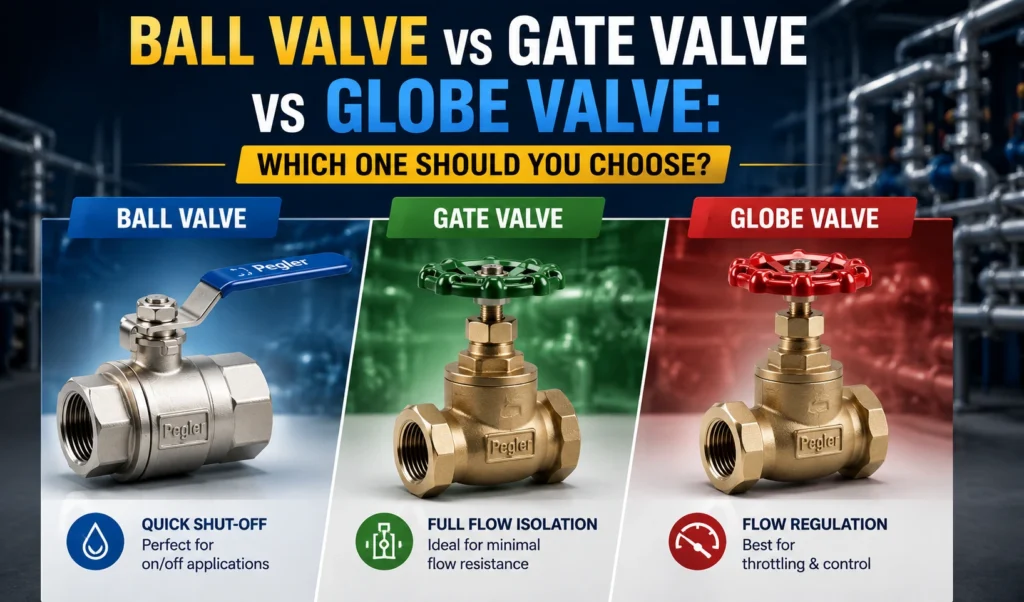
The short version: the ball valve turns, the gate valve lifts, and the globe valve squeezes. That mechanical difference decides everything else.
Definition: a ball valve uses a quarter-turn rotating sphere, a gate valve uses a rising or non-rising wedge, and a globe valve uses a disc that seats perpendicular to the flow path.
Ball Valve
Inside the body sits a sphere with a hole bored through it. Rotate the lever 90 degrees and the bore lines up with the pipe; rotate it back and the solid face of the ball meets two soft seats, usually PTFE. Nothing else moves.
That soft seat is why a ball valve seals so well. Metal-to-metal seating tolerates a smear of grit; a PTFE seat closes around it. Bubble-tight shut-off comes almost free.
Main features worth knowing: quarter-turn operation, visual position indication (lever parallel to pipe means open), bidirectional flow, and in full-bore versions, a bore equal to the pipe ID so the valve is hydraulically invisible.
Where you’ll find them: isolation at every fixture and riser branch, pump suction and discharge isolation, chilled water branch isolation, gas trains, and virtually every DN15–DN50 stop point in a modern building.
Gate Valve
A wedge-shaped gate slides down across the flow, driven by a threaded stem. Fully open, the gate retracts entirely into the bonnet and the flow path is a clear bore. Fully closed, the wedge is forced between two tapered seats by the stem thrust.
Rising stem (OS&Y) versions show you the position from across the plant room. Non-rising stem versions keep the stem inside, which is why they end up in buried and chamber applications where headroom is short.
Two things matter about that wedge. It seals metal-to-metal, so a gate valve is a good isolator but rarely a perfect one; and it must be fully open or fully closed. Nothing in between.
Common homes: main incoming water lines, pump house isolation, fire sprinkler risers (listed OS&Y types), large-diameter mains, and anywhere a valve gets operated twice a year and needs zero pressure loss the rest of the time.
Globe Valve
Flow enters, turns upward through a seat ring, meets a disc lowered onto that seat by the stem, and turns again to leave. The S-shaped path is deliberate. Because the disc approaches the seat straight on rather than sliding across it, seating pressure builds gradually and the valve throttles without tearing itself apart.
Features: unidirectional in most designs (there’s a flow arrow cast on the body, and it matters), replaceable disc and re-lappable seat, and a stroke short enough that a globe valve opens in a fraction of the turns a gate needs.
Traditional applications: steam and condensate service, boiler feed lines, bypass legs around control valves, cooling tower make-up, and small-bore process regulation.
Ball Valve vs Gate Valve vs Globe Valve at a Glance
Comparison points work better as a table than as separate sections, so here they are in one place.
| Ball Valve | Gate Valve | Globe Valve | |
|---|---|---|---|
| How it controls flow | 90° rotating bored sphere | Wedge sliding perpendicular to flow | Disc seating parallel to flow |
| Flow direction | Bidirectional | Bidirectional | Unidirectional (follow the arrow) |
| Shut-off performance | Excellent, soft seat, bubble-tight | Good, metal seat, can weep with age | Very good, tightens under pressure |
| Throttling capability | Poor. Do not use | None. Actively harmful | Excellent |
| Pressure drop (full open) | Near zero in full bore | Near zero | High, roughly 40x a gate valve |
| Turns to operate | Quarter turn | ~3 turns per inch of size | Several turns, far fewer than a gate |
| Typical applications | Isolation, frequent operation, small bore | Full-flow isolation, mains, fire risers | Regulation, steam, bypass legs |
| Maintenance | Low, but usually replaced not repaired | Moderate, stem and packing wear | Higher, though disc and seat are serviceable |
Ball Valve – Best for Quick and Reliable Shut-Off
How Does a Ball Valve Work?
Lever turns, ball rotates, bore aligns. Ninety degrees of travel takes you from fully sealed to fully open, which is the entire appeal. When a pipe bursts on the fourteenth floor at 2am, nobody wants to be counting handwheel turns.
Most plumbing ball valves are two-piece or three-piece bodies with a floating ball. Line pressure pushes the ball against the downstream seat, so the harder the system pushes, the tighter it seals.
Advantages of Ball Valves
- Fastest operation of the three, with unambiguous open/closed indication from a distance
- Tightest shut-off, thanks to soft seats rather than metal-to-metal contact
- In full bore, essentially no pressure penalty
- Handles thousands of cycles without complaint, which is why it wins on any valve that gets touched weekly
- Compact face-to-face dimension, which matters more than people admit in a crowded riser shaft
Limitations of Ball Valves
Two real ones, and the first is the reason for a lot of avoidable damage.
Quarter-turn speed plus a long pipe run equals water hammer. The Joukowsky equation puts the surge at roughly density times wave speed times velocity change; for water in steel pipe at about 1,200 m/s wave speed, killing a 2 m/s flow instantly generates around 24 bar of surge above static pressure. That is enough to split a solder joint. Slow-closing gear operators exist for exactly this reason.
Second, partial opening destroys the valve. Throttle a ball valve and the high-velocity jet at the edge of the bore erodes the seat right where it needs to be perfect. The valve will still open and close. It just won’t seal any more.
Also worth checking: standard PTFE seats top out near 180°C, and much lower once real pressure is involved. That rules them out for most steam duties.
Where Should You Use a Ball Valve?
Anywhere the valve exists to be open or shut, and gets operated regularly. Fixture isolation, apartment entry valves, branch isolation, meter sets, pump isolation up to about DN50. Above DN65 the price climbs steeply against gate and butterfly alternatives, and the crossover point is usually where the specification changes.
Gate Valve – Best for Full Flow Isolation
How Does a Gate Valve Work?
Turning the handwheel drives a threaded stem, which lifts or lowers a solid or flexible wedge between two seat faces. The wedge only seals in the last fraction of its travel, where stem thrust jams it into the taper.
There’s a rule of thumb from waterworks practice: about three turns per inch of valve size, plus a couple. A DN100 gate valve is therefore something like fourteen turns from shut to open. Slow, yes. That slowness also means a gate valve almost never causes water hammer, which is a genuine advantage on large mains.
Advantages of Gate Valves
- Unrestricted bore when open, so the pressure loss is close to a length of straight pipe
- Slow closure protects the system from surge
- Cheaper than a ball valve in larger diameters, and the gap widens as size increases
- Long service life on valves that stay in one position
- Stem packing can be re-tightened or replaced without pulling the valve out of the line
Limitations of Gate Valves
Metal-to-metal seating means a gate valve is an isolation valve, not a leak-tight one. On potable systems that’s usually acceptable. On a line you’re planning to cut and cap, don’t trust it without a second isolation point upstream.
Partial opening is the failure mode that kills gate valves. Vibration, seat erosion, gate flutter, and eventually a valve that neither controls nor closes. If you inherit a system with half-open gates, treat them as suspect.
Long stroke also means slow response, and a seized stem after years without operation is very common. Exercise them annually. Most people don’t, then discover the problem during an emergency.
Where Should You Use a Gate Valve?
Full-flow isolation that stays put. Incoming mains, pump house headers, tank connections, large-diameter distribution, and sprinkler system control valves where a listed OS&Y type with a supervisory switch is required by code. Anywhere the operating frequency is measured in years rather than weeks.
Globe Valve – Best for Flow Regulation
How Does a Globe Valve Work?
The seat sits parallel to the flow direction and the disc drops straight onto it. Because the closing element moves perpendicular to the seat instead of sliding across it, you can hold the disc at any intermediate position without shredding anything. That is the whole point of the design.
The tortuous internal path is not a flaw. It’s the price of control.
Advantages of Globe Valves
Real throttling capability, first of all, and a reasonably predictable relationship between stem position and flow. Short stroke, so it opens and closes far faster than a gate of the same size. Tight shut-off that improves as system pressure rises, since pressure helps hold the disc down. And unlike a ball valve, it is genuinely repairable: the disc is replaceable and the seat can be re-lapped in situ, which extends the life of a well-made bronze globe valve by decades.
Limitations of Globe Valves
Pressure drop, and it is not a small number.
Using resistance coefficients from Crane’s Technical Paper No. 410, the industry reference for flow through valves and fittings since 1942, a DN50 line at 3 m/s works out at roughly 0.003 bar through a full-bore ball valve, 0.007 bar through an open gate valve, and about 0.29 bar through a straight-pattern globe valve. Forty times the gate. On a single valve, irrelevant. On a riser carrying fourteen of them, that’s a different pump.
It’s also directional, so an installer who ignores the body arrow gets chatter and premature seat damage. Higher purchase cost per size, and a heavier body.
Where Should You Use a Globe Valve?
Steam and condensate. Boiler feed. Bypass legs around control valves and pressure-reducing stations. Cooling tower make-up. Any small-bore line where somebody actually needs to set a flow rate and leave it.
Here’s where I’d argue with most articles on this topic. They still recommend globe valves as the default flow-control choice for building services, and in 2026 that advice is out of date. For balancing a chilled water or LPHW circuit, a double-regulating valve or a pressure-independent control valve does the job better, holds its setting, and gives you a measurable flow reading. The globe valve’s real territory today is steam, condensate, and small-bore regulation. Specifying one to balance a heating branch is doing manually, badly, what a DRV does properly.
Ball Valve vs Gate Valve vs Globe Valve: Key Differences
Which Valve Is Best for Shut-Off?
Ball valve. Soft seats deliver bubble-tight closure that metal-seated gate valves can’t match, and floating-ball designs get tighter as pressure rises. Gate valves isolate well enough for most water service, but “well enough” and “leak-tight” are different specifications.
Which Valve Is Best for Flow Control?
Globe valve, of the three. But read the section above before you specify one for HVAC balancing.
Which Valve Has Lower Flow Resistance?
Full-bore ball and fully open gate are within a rounding error of each other, and both are close to plain pipe. Reduced-bore ball valves are a step worse because the bore necks down to roughly one size smaller. The globe valve is in another category entirely.
Which Valve Is Easier to Operate?
Ball valve, and it isn’t close. One quarter turn versus fourteen turns of a handwheel on a DN100 gate. Position is visible from across the room, which matters during a leak at 3am when nobody can remember which way is closed.
Which Valve Is Better for Frequent Operation?
Ball valve again. Cycle life is where the design earns its cost. Gate valves suffer stem and packing wear under repeated operation, and globe valves wear the disc face. If a valve gets touched more than a few times a year, specify a ball valve.
Which Valve Is Best for Different Plumbing Applications?
Residential Plumbing
Ball valves, nearly everywhere. Fixture stops, apartment entry, water heater isolation, manifold branches. Compact, quick, and cheap in small sizes. Full bore for main isolation, reduced bore where budget is tight and the branch has spare head.
Commercial Buildings
Mixed by size. Ball valves up to DN50, gate or butterfly above. Retail and office fit-outs get reconfigured constantly, so put isolation at every tenancy boundary and use ball valves there.
HVAC Systems
Ball valves for isolation at coils, pumps and branches. DRVs or PICVs for balancing. Globe valves only in steam or condensate legs. The mistake that shows up on commissioning reports again and again is a system balanced on isolation valves, which then get closed for maintenance and reopened to a guessed position.
Water Supply Systems
Gate valves on mains and large distribution where the valve sits open permanently and every millibar of head counts. Ball valves at every branch and service connection. On buried lines, non-rising stem gates with a surface box.
Material matters more than valve type here. Ordinary brass in hot water service is a known dezincification risk, and dezincified brass fails by crumbling from the inside. Specify DZR (CW602N, marked CR) or bronze, and check that potable components carry a recognised approval such as a WRAS listing alongside local authority requirements.
Industrial Applications
Depends entirely on media, pressure and temperature. Steam pushes you to globe valves in cast steel or bronze. Slurries and anything with solids rule out gate valves, because the seat pocket packs solid and the wedge never fully seats again. High-cycle process isolation goes to ball valves.
MEP Projects
The commercial reality: valve selection on a large MEP job is usually decided by schedule and approved vendor list rather than by hydraulics. Get the type right at design stage, because substituting a gate for a globe on site to save two weeks creates a problem that turns up at handover, when nobody has time for it.
Fire systems are the exception where there’s no judgment call. UAE Fire and Life Safety Code requirements follow NFPA practice, so sprinkler control valves must be listed indicating types, supervised. An unlisted ball valve on a sprinkler riser fails inspection, and it should.
How to Choose the Right Valve for Your Project
Consider the Pipe Size
Below DN50, ball valves win on price, speed and space. Between DN50 and DN80 the economics tighten. Above DN80, gate and butterfly valves take over, and a large ball valve needs to justify itself with a specific requirement, such as full bore for pigging or absolute leak tightness.
Check Pressure and Temperature
Look at the pressure/temperature curve, not just the PN rating. A PN16 bronze valve doesn’t hold 16 bar at 150°C. And confirm the seat material: PTFE has a hard ceiling that steam service walks straight through.
Understand the Required Flow Control
Ask one question. Will this valve ever sit at a position between open and closed? If yes, it’s a globe valve or a purpose-made regulating valve, and never a gate or ball valve. If no, choose on speed, size and cost.
Consider Installation Location
Riser shafts, ceiling voids and plant rooms all have different constraints. A gate valve needs headroom above the bonnet for the rising stem, which people forget until the valve won’t fit. A ball valve needs lever swing clearance. Neither problem appears on a P&ID.
Think About Maintenance and Accessibility
Valves behind plasterboard get replaced, not repaired. Valves in accessible plant rooms can be serviced, which shifts the maths in favour of a bronze globe or gate valve whose seats and packing can be renewed. Access panel or no access panel is a real specification input.
Consider Long-Term Operating Cost
Take that 0.29 bar globe valve pressure drop. Pumping 20 l/s through it takes roughly 0.8 kW of extra pump input at typical efficiency. Run that 8,000 hours a year and it’s around 6,600 kWh, every year, from one badly chosen valve. Price it at your DEWA tariff and the purchase price stops looking like the main number.
Pegler Valves for Plumbing Applications
Why Valve Quality Matters in Building Projects
Valve failures are rarely dramatic. A stem packing weeps onto a ceiling tile. A seat passes and a maintenance team can’t isolate a floor without shutting a riser. A cheap gate valve seizes and someone applies a wrench extension, and now there’s a snapped stem inside a live main.
The replacement valve costs very little. The access, the drain-down, the make-good and the tenant disruption cost a great deal more. That ratio is the entire argument for buying a known brand on a building that has to run for thirty years.
Where Pegler Valves Can Be Used
Pegler is a long-established British valve brand with a deep range in bronze and DZR brass for building services, covering ball, gate, globe and check valves in the sizes plumbing and MEP contractors use daily. Typical uses run from domestic water and LPHW heating to chilled water isolation and commercial hot water services. Sourcing matters as much as brand: counterfeit and grey-market valves are a real problem in this region, which is why buying through a Pegler Authorized Distributor UAE is worth the small premium over an unnamed trader.
Choosing the Right Pegler Valve for Your Application
Match three things and you’ll rarely go wrong: the body material to the media, the pressure/temperature rating to the system’s worst case rather than its design case, and the valve type to the duty using the logic in this article. Certification comes fourth, and it’s the one procurement teams check last and regret most. For a walkthrough of the range and the selection logic behind it, see our guide on how to choose the right Pegler valve.
Common Valve Selection Mistakes to Avoid
Choosing only on price. A DN25 gate valve at a third of the branded price is not the same valve. Thinner wall sections, unspecified alloy, and a stem that rounds off under a wrench. The saving evaporates the first time somebody has to reach it behind a ceiling.
Using the wrong valve for flow regulation. Throttling with a gate valve wrecks the wedge and seat within a year or two. Throttling with a ball valve erodes the seat edge and destroys the shut-off it was bought for. Both are avoidable with one correctly specified regulating valve.
Ignoring pressure and temperature. Specifically, ignoring the derating curve. PN ratings are quoted at ambient, and a hot water system at 90°C is nowhere near ambient.
Selecting the wrong size. Oversized valves throttle badly and cost more. Undersized valves add head permanently. And reduced-bore ball valves specified in a run that’s already tight on head give you a pressure problem nobody can find on a drawing.
Overlooking maintenance requirements. Every isolation valve should be operable by one person with normal tools, from a position they can actually stand in. If that’s not true, the valve won’t get exercised, and an unexercised valve is a seized valve.
Frequently Asked Questions About Ball, Gate and Globe Valves
Which is better, a ball valve or a gate valve?
For isolation under DN50 that gets operated regularly, the ball valve is better: faster, tighter sealing, and longer cycle life. For large-diameter mains that stay open for years, the gate valve is cheaper and its slow closure protects against surge. Size and operating frequency decide it.
What is the main difference between a gate valve and a globe valve?
A gate valve is on/off only, with almost no pressure loss when open. A globe valve can throttle at any position but costs roughly forty times the pressure drop. Gate valves isolate. Globe valves regulate. Using either one for the other job damages it.
Which valve is best for flow control?
The globe valve, among these three, because its disc seats perpendicular to flow and tolerates partial positions. For balancing HVAC circuits specifically, a double-regulating valve or a PICV is the better modern choice, since it holds its setting and allows flow measurement.
Which valve is best for water supply systems?
Gate valves on mains and large distribution lines, ball valves at branches and service connections. In hot water service, material matters as much as type: use DZR brass or bronze to avoid dezincification, and confirm potable approval for anything on drinking water.
Can a ball valve be used for throttling?
No, not as a permanent arrangement. In a partially open position, flow accelerates past the edge of the bore and erodes the seat, so the valve loses its bubble-tight shut-off. Brief throttling during commissioning is survivable. Leaving it half open is not.
Which valve requires less maintenance?
The ball valve, with no packing adjustment and no seat lapping in normal service. The trade-off is that when it does fail, you replace it rather than repair it. Bronze gate and globe valves need more attention but can be rebuilt in the line.
Final Verdict: Which Valve Should You Choose?
Strip out everything else and the ball valve vs gate valve vs globe valve decision comes down to one question: what is this valve for?
Quick, reliable shut-off, operated often, DN50 and below? Ball valve.
Full-flow isolation on a main that stays open for years? Gate valve.
Actual flow regulation, especially steam or condensate? Globe valve, unless it’s an HVAC balancing duty, in which case use a DRV.
One next step: walk your existing plant room and look for gate valves sitting part-open. Every one you find is a valve that has already been chosen wrong and is quietly failing. Replacing those with the right type is the cheapest reliability win available on most buildings.