
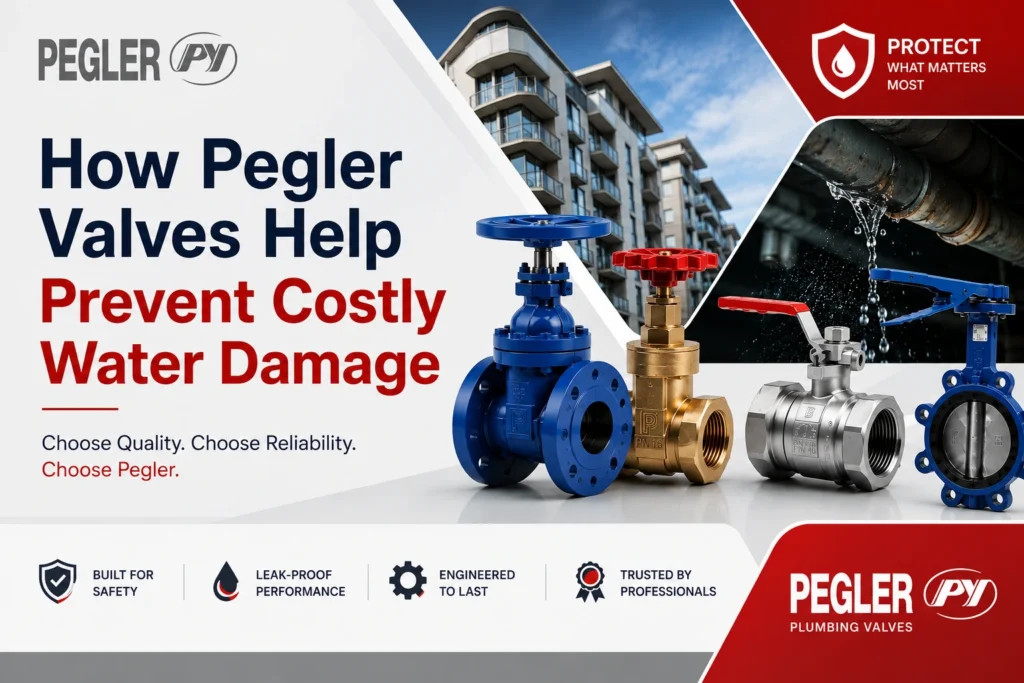
A saturated gypsum ceiling board starts losing structural strength somewhere around the six to eight hour mark, and in Dubai’s humidity mould colonies can take hold inside 24 hours. That is the real window you are buying against when you specify a Pegler Yorkshire valve Dubai. Not an abstract idea of British engineering quality. A number of hours.
Most articles on this topic will now tell you that Pegler makes excellent valves and that you should buy them. Both true. Both useless on their own, because the component that fails first in a Dubai tower is almost never the one people inspect, and because the finest valve in the building cannot stop water it was never installed to stop.
So let’s do the version nobody publishes.
Dubai water is harder on brass than most people specifying valves realise
Dezincification is the quiet one. Brass is copper and zinc; under certain water conditions the zinc leaches out selectively and leaves behind a porous, chalky structure that looks fine from the outside and has lost most of its mechanical strength. You don’t see it. You find out when a threaded section fractures.
The conditions that accelerate it are chlorides, water hardness, high temperatures and low flow. Read that list again and then think about a Dubai residential tower: desalinated supply, hot water risers running well above ambient, and long stretches of pipework sitting in ceiling voids that get properly hot from May onward. Guest bathrooms in half-occupied units sit stagnant for months at a time.
There is engineering literature going back decades describing valve stems in high-rise hot water lines, at 60 to 80°C, suffering dezincification corrosion within one to three years of installation. One to three years. On a building with a 30-year design life.
The material answer is dezincification-resistant brass, usually specified as CW602N under EN 12165, where small additions of arsenic, tin or phosphorus stabilise the microstructure and stop the zinc walking off. Resistance is verified under ISO 6509: samples sit in a copper chloride solution at roughly 75°C for around 24 hours, and the depth of attack is measured.
The one question that separates real stock from grey stock
Ask your supplier for the alloy designation and the ISO 6509 result. Not the brochure. The designation.
A genuine distributor will produce it without drama, because the manufacturer publishes it. A trader who bought a pallet through three intermediaries usually cannot, and the answer you’ll get instead is some version of “it’s original, don’t worry.” That is your answer. We have turned away batches for exactly this reason, and we would rather lose a sale than put an unverifiable valve behind somebody’s kitchen sink.
The valve that fails first is the one nobody ever touches
Failure modes are not evenly distributed. Some ruin your evening; one ruins your ceiling.
| Valve | How it typically fails in a UAE building | What it actually costs you |
|---|---|---|
| Gate valve on the riser | Stem seizes in the open position. The handwheel turns, the gate does not | You find out at 2am, during the emergency, when it will not close |
| Ball valve at fixture isolation | Gland weeps first, then the stem shears when someone forces it | A slow drip inside a cabinet becomes a spray nobody sees for a week |
| Angle valve behind WC or basin | Compression joint relaxes; a dezincified thread cracks under load | Seepage into the slab, usually reported by the neighbour below you |
| Pressure reducing valve | Setting drifts upward over years and nobody rechecks it | Standing pressure creep that fatigues every joint in the flat at once |
Notice the pattern. Three of those four are components that get installed once and then ignored for a decade. The gate valve is the worst of them, because it is the one you are relying on in an emergency and the one least likely to work when you need it.
Where Pegler sits, and where it doesn’t
Worth being accurate about the brand, because procurement people check. Pegler Yorkshire now sits inside the Integrated Piping Systems division of Aalberts N.V. The heritage goes back to the 1890s in Doncaster; the ownership is Dutch and has been for years. If a supplier is still selling you on “independent British manufacturer,” they haven’t read a datasheet since 2010.
The current Pegler valve portfolio under Aalberts covers butterfly, ball, gate and globe valves, plus strainers and pressure reducing valves. The specifications are published and specific, which is the part that matters for Pegler plumbing valve supply in a market with a counterfeit problem. Take the 808 series chrome-plated reduced-bore ball valve: manufactured to BS 6675, rated 16 bar at 30°C cold and 5 bar at 120°C hot. Those numbers are checkable. That is the entire point of buying a specified brand.
Now the honest limitation, since you’ll work it out anyway.
Pegler is not the right answer for everything. On large-diameter district cooling headers, on certain fire protection assemblies with their own approval regimes, and on budget refurbishment jobs where the client genuinely will not fund premium brassware across 200 units, there are better-matched options. A good gate valve supplier will tell you which situation you’re in rather than quoting the expensive line by default. If we think a mid-tier valve with correct DZR certification serves you better than a premium one, we say so.
The uncomfortable part: your isolation layout matters more than your brand
Here is the argument, and plenty of people in this trade will push back on it.
The brand stamped on the valve body is not what prevents water damage. The isolation layout is.
A building with one main stopcock and no fixture-level isolation will flood. It will flood with Pegler valves, it will flood with unbranded valves, and the only difference is how much you paid for the privilege. When a flexible hose lets go under a vanity at midnight, the question is not what alloy the main riser valve is made from. The question is whether there is a working isolation point within two metres of the leak, whether anyone knows where it is, and whether it has been turned in the last five years.
An angle valve costing a few dirhams, installed at every fixture and exercised twice a year, prevents more damage than a premium valve installed as the sole isolation point for an entire apartment. That is not an argument against buying quality. It is an argument about sequence: get the layout right first, then spend money on the valves that layout requires.
Escape of water is not a small category of loss, either. UK data is the cleanest public dataset on this, and comparison site Go.Compare’s analysis of home insurance claims found escape of water was the single most common claim type in 2025, at 29.3% of all claims. The UAE has no equivalent public figure, so treat that as directional rather than local. The mechanism is identical. The drying costs here are worse.
Common mistakes with Pegler valve sourcing in the UAE
Named specifically, because vague warnings help nobody:
- Buying on part number alone. The part number tells you the geometry. It does not confirm the alloy in front of you matches the alloy on the datasheet, which is the exact gap counterfeiters operate in.
- Mixing dissimilar metals at the joint without an isolating fitting, then blaming the valve when galvanic corrosion eats the connection in three years.
- Over-torquing chrome-plated bodies on installation. Chrome plating hides the hairline stress it puts into the brass underneath, and the crack shows up months later as a weep nobody can trace.
- Assuming “dealer” and “authorised distributor” mean the same thing. They don’t, and the difference only becomes visible when you need warranty support, batch traceability, or ten units of a size in the same afternoon. Anyone can print “Pegler dealer” on a shopfront in Deira. Ask instead who they buy from, whether they hold stock or drop-ship, and whether they can tell you which batch your valves came from. If the answers are vague on all three, you are buying from a reseller of a reseller, and the price you’re paying is a brand-name price for an unverifiable product.
- Never exercising the valve. Isolation valves that sit untouched for a decade seize. Two full turns, twice a year, costs nothing and is the single highest-return maintenance task in the building.
What to actually check before you place the order
Four things, in order of how often they get skipped.
Documentation first: alloy designation, standard, and test certificate, in writing. Batch traceability second, so that if a fault pattern emerges you can identify every unit from that run rather than guessing. Third, stock depth on the sizes you will genuinely need in a hurry, because a supplier with a beautiful catalogue and an empty warehouse is worse than useless during an emergency callout. Our own DZR gate valve and isolation stock in Dubai is held locally for exactly this reason.
Fourth, and hardest to test: whether they will tell you when a cheaper valve is the correct answer. A supplier who never recommends down is selling, not advising.
Frequently Asked Questions
Q: Are Pegler Yorkshire valve dubai suitable for Dubai water? A: Yes, provided you specify dezincification-resistant brass. Dubai’s desalinated supply, chloride content and high pipe temperatures make DZR alloy the sensible default rather than an upgrade. Ask for the CW602N designation under EN 12165 and the ISO 6509 test result before ordering.
Q: What is the difference between DZR brass and normal brass valves? A: Standard brass loses zinc selectively in aggressive water, leaving a porous structure that fractures without warning. DZR brass adds small amounts of arsenic, tin or phosphorus to stabilise the alloy. Externally the two look identical, which is why documentation matters more than inspection.
Q: How often should isolation valves be checked in a UAE apartment? A: Twice a year, and it takes about ten minutes. Turn each isolation valve fully closed and fully open again to stop the stem seizing. Check for weeping at the gland. Confirm every occupant knows where the main shut-off is located.
Q: Is Pegler Yorkshire the same company as Aalberts now? A: Pegler Yorkshire operates within the Integrated Piping Systems division of Aalberts N.V. The Pegler brand, product range and specifications continue. If you are cross-referencing older drawings against current datasheets, this is why the branding shifted.
Start with the valve behind your washing machine
Pick one fixture today. The washing machine is usually the right choice, because flexible hoses fail more often than pipework and the appliance sits against a wall where a leak runs unnoticed for days.
Find its isolation valve. Close it fully, open it fully. If it seizes, weeps, or does not exist, you have found the weakest point in the flat and it costs very little to fix this week. Then repeat under every sink.
Do that first. Then have the conversation about which Pegler Yorkshire valve belongs in Dubai buildings like yours, with the alloy certificate in hand.
Junaid is a Pegler valve distributor in Dubai, and we hand you the alloy certificate before you think to ask for it.