
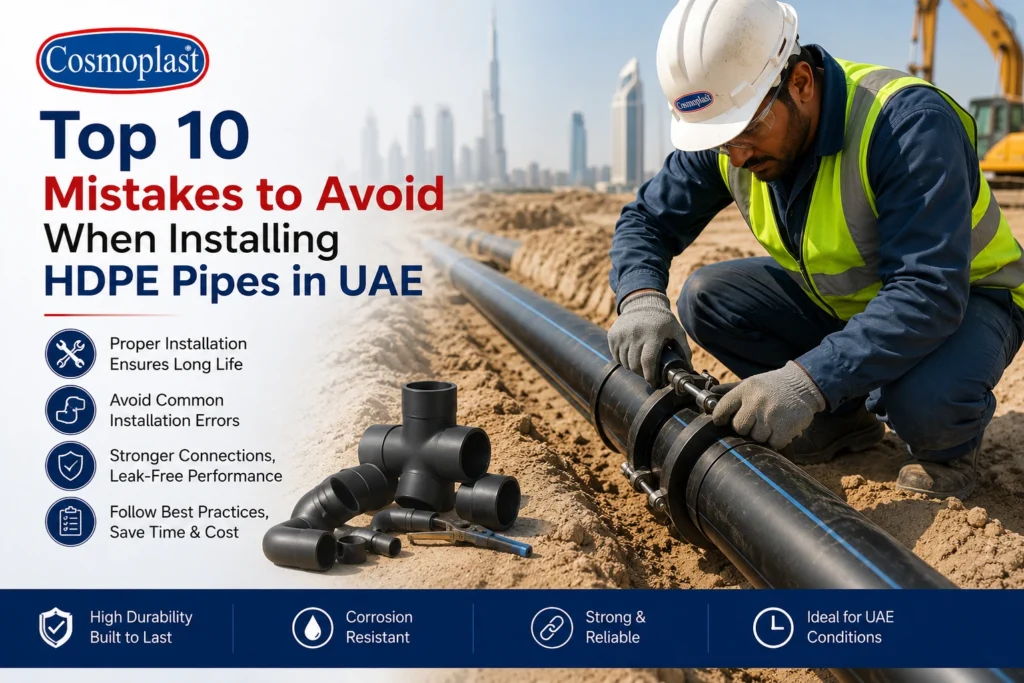
A single installation error with HDPE pipes can cost tens of thousands of dirhams in repairs, project delays, and water damage — especially in UAE’s demanding construction environment. If you’re sourcing Cosmoplast HDPE pipes & fittings UAE for a residential, commercial, or infrastructure project, getting the installation right matters as much as the product quality itself.
The good news? Most of these mistakes are completely avoidable. Here are the 10 most common errors UAE contractors, homeowners, and project managers make when installing HDPE pipes — and exactly how to fix them before they become expensive problems.
1. Choosing the Wrong Pressure Rating (PN Rating)
Not all HDPE pipes handle the same pressure. In UAE, municipal water supply systems often operate at higher pressures than what’s typical in cooler climates — and installing a low-PN pipe in a high-pressure line will cause premature failure.
The two most common ratings you’ll work with are PN10 and PN16. PN10 handles up to 10 bar and suits standard drainage or low-pressure supply lines. PN16 is rated for up to 16 bar and is required for main water supply and pressurized irrigation systems.
Here’s what most people get wrong: they pick the pipe based on budget, not application. Always match the PN rating to the system’s operating pressure — then add a safety buffer of at least 20%. The ESMA pipe standards for UAE clearly define minimum pressure class requirements per application type. When in doubt, go one grade higher.
2. Ignoring UAE Climate Factors During Installation
UAE’s extreme heat isn’t just uncomfortable for workers — it directly affects HDPE pipe behavior during installation. Ground temperatures in summer can exceed 55°C in shallow trenches, which causes HDPE to expand significantly before burial.
If you install a fully expanded pipe without accounting for thermal contraction at night or in cooled environments, you’ll end up with buckling, joint stress, and gaps at connections. Schedule critical fusion work during early morning hours when temperatures are most stable. This is especially important for HDPE pipe Dubai projects where ground surface temperatures spike between June and September. The UAE Meteorology & Climate Centre publishes monthly ground temperature data that can help project managers plan installation windows.
3. Using Incompatible Fittings From Multiple Brands
Mixing fittings from different manufacturers seems cost-effective until a joint fails. The internal geometry, wall thickness tolerances, and SDR ratios vary between brands — even when the pipe diameter is identical.
With Cosmoplast HDPE pipes & fittings UAE, the entire system is engineered as a matched set. The fittings are dimensionally calibrated for Cosmoplast pipe wall tolerances, which means fusion temperatures, cooling times, and joint integrity are all optimized together. Swapping in fittings from an unverified HDPE fittings supplier Dubai just to save a few dirhams per fitting is a risk that simply isn’t worth it on any serious project.
4. Skipping Proper Pipe Fusion Techniques
HDPE pipe joints are only as strong as the fusion process behind them. There are two main methods: butt fusion and electrofusion. Both work well — but both have specific procedural requirements that are frequently ignored on busy UAE sites.
Butt fusion errors include incorrect heating plate temperature (should be 200–220°C for most HDPE grades), insufficient melt bead formation, and premature joint movement during cooling. Electrofusion errors typically involve dirty pipe surfaces, incorrect saddle positioning, or interrupted power supply during the weld cycle.
One rule applies to both methods: never rush the cooling time. A joint that looks solid after 2 minutes may still be structurally weak. Follow the manufacturer’s minimum cooling time — this data is specified in the ISO 4427 standard for polyethylene pipes and is also available in Cosmoplast’s product datasheets.
5. Incorrect Burial Depth and Bedding Material
UAE soil varies significantly between coastal sand, rocky desert terrain, and engineered fill in development zones. Each type requires a different bedding approach for HDPE pipes.
The minimum burial depth for HDPE water supply lines under roads in Dubai is typically 1.0m to 1.2m, as defined in Dubai Municipality construction regulations. Under pedestrian areas, 0.6m is usually acceptable. Shallow burial without proper bedding material — fine sand or pea gravel compacted in 150mm layers — leads to point loading on the pipe and eventual deformation over time.
Never use sharp aggregate or excavated rocky material directly against HDPE pipes. It scratches the surface and creates stress concentration points that eventually crack under pressure cycles.
6. Not Pressure Testing Before Backfilling
This is one of the most expensive mistakes you can make. Once a trench is backfilled, finding and repairing a failed joint means excavating the entire run — costing days of work and thousands in labour.
Dubai Municipality and DEWA both require pressure testing of water supply lines before backfilling on permitted projects. The typical hydrotest protocol for HDPE pipes involves pressurizing to 1.5x the operating pressure, holding for a minimum of one hour, and monitoring for pressure drop. If pressure drops more than 5% during the test window, the joint needs inspection before any soil goes back in.
Don’t skip this step even on private projects where permits aren’t required. It’s the one test that saves everything.
7. Poor Storage and Handling Before Installation
HDPE is UV-sensitive over extended periods. Pipes stored exposed to direct UAE sunlight for weeks or months before installation can experience surface oxidation and reduced impact strength — even if they look fine externally.
Proper site storage means stacking pipes on flat supports, covering with opaque sheeting, and keeping them out of direct contact with the ground. Pipe ends should be capped to prevent insects, sand ingress, and moisture contamination — all of which affect fusion joint quality.
Also, never drag HDPE pipes across rough ground. Dragging creates longitudinal scratches that may not be visible but can propagate into cracks under sustained pressure.
8. Overlooking Expansion Loops in Long Pipe Runs
For long horizontal runs — anything over 30 metres — thermal expansion loops or expansion joints are not optional. HDPE has a thermal expansion coefficient of approximately 0.15 mm/m/°C, as documented in Plastics Pipe Institute engineering guidelines. In UAE’s climate, a 100-metre above-ground pipe run can expand and contract by over 200mm seasonally.
Without expansion loops, this movement loads every fixed connection, support bracket, and junction fitting with cumulative stress. On above-ground installations common in industrial facilities, warehouses, and plant rooms across Dubai, ignoring this detail is the leading cause of fitting failures at the 2–3 year mark.
9. Hiring Unqualified Labour for Fusion Joints
HDPE pipe fusion is a skilled trade. It’s not something a general labourer can learn in an afternoon. Both butt fusion and electrofusion require calibrated equipment, proper technique, and the experience to recognize when a joint hasn’t formed correctly.
In UAE, projects under Dubai Municipality or Abu Dhabi DOT jurisdiction typically require fusion operators to hold valid certification from the pipe manufacturer or an accredited training body. Using uncertified workers isn’t just a quality risk — it can invalidate your project warranty and create liability if a failure causes property damage or service disruption.
When sourcing from a reputable HDPE pipe distributor in Dubai, ask whether they offer or can refer certified fusion technicians. Established suppliers usually maintain a network of qualified installers for exactly this reason.
10. Not Sourcing From a Verified HDPE Pipe Supplier UAE
The UAE market has seen a rise in substandard HDPE pipes that look identical to certified products but fail to meet international standards like ISO 4427 or DIN 8074. Always source from authorized HDPE pipe suppliers UAE who can provide full traceability — batch test certificates, material compliance declarations, and conformity to ESMA standards.
Cosmoplast is one of the few HDPE pipe manufacturers UAE with in-house testing facilities and full ISO certification. Their products are compliant with UAE construction authority requirements and come with documented quality assurance. Browse their complete range of Cosmoplast HDPE pipes and fittings at Junaid Group — including technical datasheets to verify specifications before ordering.
Frequently Asked Questions
Q: What is the best HDPE pipe for water supply in UAE?
A: For potable water supply in UAE, HDPE pipes rated PE100 with a minimum PN10 pressure class are recommended. Cosmoplast HDPE pipes & fittings UAE meet ISO 4427 and ESMA standards, making them a reliable choice for both residential and commercial water supply systems across Dubai and the wider UAE.
Q: How do I find a reliable HDPE pipe supplier in Dubai?
A: Look for an HDPE pipe supplier Dubai that provides batch test certificates, ISO conformity documents, and ESMA compliance. Verify that they stock genuine branded products — not grey-market alternatives. Junaid Group (store.junaidworld.com) is an authorized distributor of Cosmoplast HDPE pipes and fittings in the UAE.
Q: Are Cosmoplast HDPE pipes approved for UAE construction projects?
A: Yes. Cosmoplast is one of the leading HDPE pipe manufacturers UAE with full ISO certification and ESMA-compliant products. Their HDPE pipes and fittings are widely used on Dubai Municipality, DEWA, and Abu Dhabi DOT-approved projects across residential, commercial, and infrastructure sectors.
Final Thoughts
HDPE pipes are one of the most durable, cost-effective, and chemically resistant piping solutions available in the UAE market. But that durability only shows up when the installation is done right. The mistakes covered here are real, common, and entirely avoidable — provided you work with quality materials, qualified installers, and a supplier who stands behind what they sell.
If you’re planning a project and need verified Cosmoplast HDPE pipes & fittings UAE, browse the full product range at store.junaidworld.com or get in touch with the Junaid Group team for technical guidance and project-specific recommendations.