
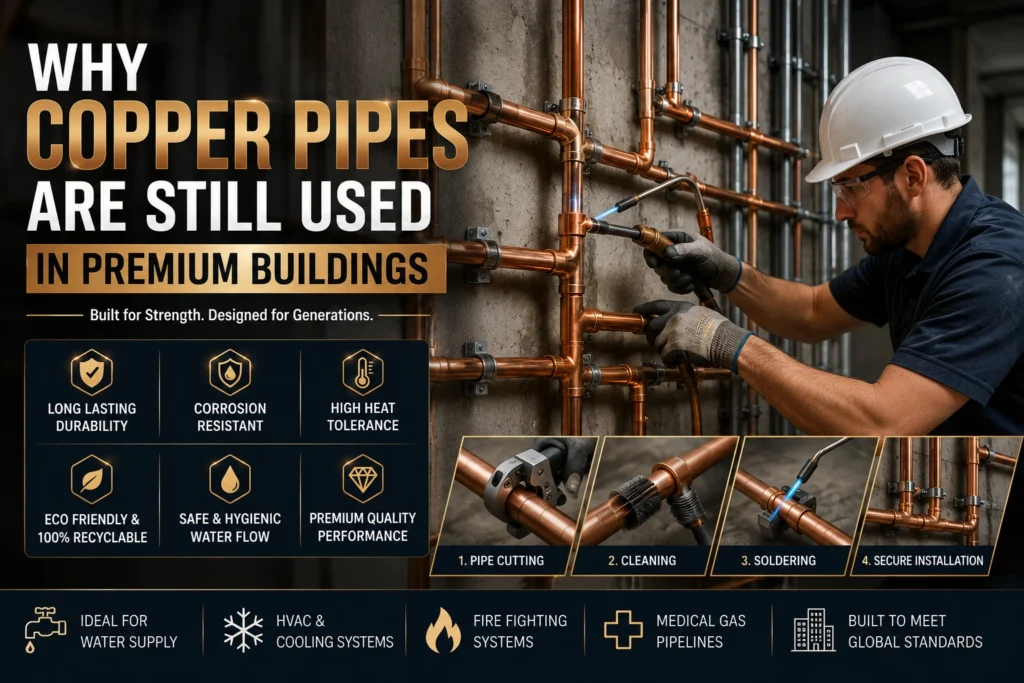
A contractor friend of mine once ripped out an entire bathroom’s PPR plumbing after just four years — the joints had gone brittle from the heat behind the walls. The villa was less than five years old. That’s not a rare story in Dubai. It’s why, even with a dozen cheaper plastic alternatives on the market, developers building premium towers and villas keep coming back to one material: copper.
If you’ve been comparing options and searching for dependable copper pipe suppliers in dubai, this isn’t going to be another generic “copper is good” article. It’s a straight look at why copper still wins in high-end builds, what sizes and fittings actually matter, and what to check before you buy.
Why Premium Buildings in Dubai Still Choose Copper Pipes
Here’s the thing about premium construction — nobody wants a callback five years after handover. Developers building luxury villas in Emirates Hills or high-rise towers on Sheikh Zayed Road aren’t choosing materials based on upfront cost. They’re choosing based on what survives 86°C ambient heat behind drywall, hard water, and decades of pressure cycling without a single leak.
Copper handles all three. It doesn’t soften under heat the way plastic pipe can, and it forms a natural oxide layer that protects it from corrosion instead of breaking down. Manufacturing of seamless copper tube for water and gas systems is governed by the BS EN 1057 standard, which sets out requirements, sampling, and test methods for seamless round copper tubes used in hot and cold water distribution. Serious suppliers and MEP consultants in the UAE still spec copper tube against this benchmark rather than accepting unmarked stock. If a supplier can’t tell you which standard their copper pipe is certified against, that’s your first red flag.
There’s also a health angle most homeowners never hear about. According to the Copper Development Association, independent lab testing has shown that copper, brass, and bronze surfaces kill more than 99.9% of several harmful bacteria strains within two hours of exposure when cleaned regularly — which is one reason hospitals and high-end residential projects still favor it for water lines. Plastic pipe doesn’t do that.
Copper Pipe vs Cosmoplast/PPR — What Actually Lasts Longer
I’ll be direct: PPR and Cosmoplast pipe are fine for budget projects, and they’re cheaper to install. But in real-world UAE conditions — direct sun exposure on rooftop tanks, high ambient heat in risers, and years of thermal expansion and contraction — copper pipe and fittings consistently outlast plastic. Most plumbers I’ve worked with will tell you the same thing off the record: PPR failures cluster around the 5–8 year mark in poorly insulated risers, while copper installations from the same era are still leak-free. That’s not a knock on PPR everywhere — it’s a description of what happens specifically in hot, high-pressure UAE plumbing risers.
Copper Pipe and Fittings — Sizes, Types & Use Cases
This is where most homeowners get confused, and honestly, where a lot of budget suppliers cut corners.
10mm copper pipe — Used for basin and sink connections, and short branch runs where flow demand is low. Not suitable as a main feed line.
12mm copper pipe — A step up, common for secondary bathroom fixtures and shower feeds where you need slightly more flow without going to a full riser size.
15mm copper pipe fittings — This is the workhorse size for most residential branch lines feeding taps, showers, and water heaters in villas and apartments. If your plumber specs 15mm for a water heater feed, that’s standard practice, not a downgrade.
Fittings matter just as much as the pipe itself. A perfectly rated copper tube installed with the wrong fitting will still leak.
Copper Compression Fittings — When to Use Them
Copper compression fittings are the go-to choice when you need a mechanical joint without soldering — think under-sink connections, water heater retrofits, or any spot where an open flame near existing finishes isn’t practical. They work by compressing a ferrule onto the pipe using a nut, creating a seal without heat. The trade-off: they need periodic inspection, since a slightly under-tightened compression joint is one of the most common causes of slow leaks behind cabinetry.
For permanent, high-pressure risers, soldered (capillary) joints are still the stronger long-term choice. Compression fittings shine in retrofit and maintenance scenarios where accessibility matters more than permanence.
A copper pipe coupling is the simplest fitting in the lineup — it joins two straight lengths of pipe in a line. Sounds basic, but a mismatched coupling (wrong wall thickness or diameter) is one of the top reasons DIY plumbing repairs fail inspection. Always match coupling internal diameter to the exact pipe OD you’re using — 15mm coupling on 15mm pipe, not “close enough.”
What Homeowners & Buyers Should Look for in Copper Pipe Suppliers in UAE
Not all copper pipe suppliers in UAE are equal, and the difference isn’t always visible until a joint fails two years in.
Check certification first. Ask for the specific standard the tube is manufactured to, and confirm the wall thickness matches what’s stamped on the delivery note — not just what’s quoted verbally.
Check purity and temper. Half-hard (R250) copper tube is standard for most residential branch lines; hard-drawn (R290) shows up more in long straight commercial runs. A supplier who can’t explain the difference probably isn’t stocking properly graded material.
Don’t chase the cheapest quote blindly. In my experience supplying plumbing materials across Dubai projects, the biggest cost overruns on “value engineered” plumbing don’t come from the pipe price — they come from callback labor after uncertified fittings fail. A slightly higher unit cost on certified copper pipe and fittings is almost always cheaper over a 10-year horizon than repeat maintenance visits.
If you’re sourcing for a villa renovation or new build, browsing a supplier’s copper pipe and fittings range before finalizing your MEP contractor’s BOQ is worth the extra hour — it lets you cross-check sizes and grades against what’s actually being quoted.
Common Mistakes People Make With Copper Pipe and Fittings
Mixing incompatible metals without dielectric separation. Connecting copper directly to galvanized steel fittings without a proper isolating union accelerates corrosion at the joint — this is one of the most overlooked mistakes on residential sites.
Using the wrong pipe gauge for water heaters. Undersized pipe on a water heater feed restricts flow and increases pressure stress at the joints over time.
Skipping proper flux application before soldering. A rushed solder joint without clean flux coverage is one of the leading causes of pinhole leaks that show up months later, not immediately.Buying uncertified or unmarked copper fittings. If a fitting has no standard marking and no traceable batch, you have no way to verify wall thickness or pressure rating — and neither does your plumber
Frequently Asked Questions
Q: Are copper pipes better than PPR pipes in UAE?
A: For long-term durability in high-heat, high-pressure conditions, yes — copper generally outlasts PPR in UAE risers and water heater feeds. PPR remains a valid, cheaper option for lower-demand budget installations.
Q: What size copper pipe is used for water heaters?
A: 15mm copper pipe is the standard size for most residential water heater feed and return lines in villas and apartments, though larger commercial units may require bigger diameters.
Q: Are copper pipe fittings expensive compared to plastic?
A: Per unit, yes — copper fittings cost more upfront than plastic. Over a 10+ year lifespan, though, the lower failure and callback rate usually offsets that difference.
Final Thoughts
Copper isn’t the cheapest plumbing option on the shelf, and it was never meant to be. It’s the option premium builds choose because a leak behind a marble-clad wall costs a lot more than the pipe ever did. If you’re speccing a villa, apartment renovation, or luxury interior project, start by confirming certification and correct sizing with your supplier before you sign off on the BOQ — that single step prevents most of the callbacks I’ve seen on real sites