
Most clamp failures aren’t material failures. Ask any site supervisor who’s had to redo a chiller line six months after handover, and the story is rarely about a clamp snapping. It’s about the wrong clamp holding the right pipe. A U clamp doing a U bolt’s job. A galvanized strap on a copper line, quietly corroding from the inside out. None of it shows up on day one. It shows up in month four, usually as a leak, sometimes as a vibration complaint from the floor below.
Choosing a clamps supplier in UAE isn’t really about finding someone who sells clamps. Every hardware shop in Ras Al Khor sells clamps. It’s about finding a supplier who stocks the right range for the system you’re actually building, not the system on a generic catalog page.
What a Clamps Supplier in UAE Actually Needs to Stock
UAE conditions aren’t neutral. Ambient heat above 45°C in summer, high humidity near the coast, and long-duration HVAC and chilled water lines running through most commercial buildings — all of it changes what “the right clamp” means here compared to a cooler, drier market.
A pipe clamp distributor in UAE working with commercial or industrial clients needs galvanized steel for standard structural runs, stainless steel (usually 304 or 316) for anything coastal or exposed, and rubber-lined options for vibration-prone lines. DIN 3567 and JIS standards come up constantly in specs from consultants, and a supplier who can’t quote against them is going to lose the tender regardless of price. Stock depth matters more than most buyers realize going in. A supplier with three sizes in stock and forty on a PDF isn’t really a supplier — they’re a middleman with a lead time problem.
For a broader look at how clamps sit within the full support system — hangers, brackets, rods — Junaid World’s plumbing hangers and supports page is a useful reference point before narrowing down to clamp type specifically.
U Clamp vs U Bolt Clamp — They’re Not the Same Thing
Here’s where most buyers, even experienced procurement people, get sloppy. “U clamp” and “U bolt clamp” get used interchangeably in verbal orders, in WhatsApp messages to suppliers, sometimes even in BOQs. They’re not the same fitting, and treating them as synonyms is exactly how the wrong part ends up on site.
Where a U clamp works
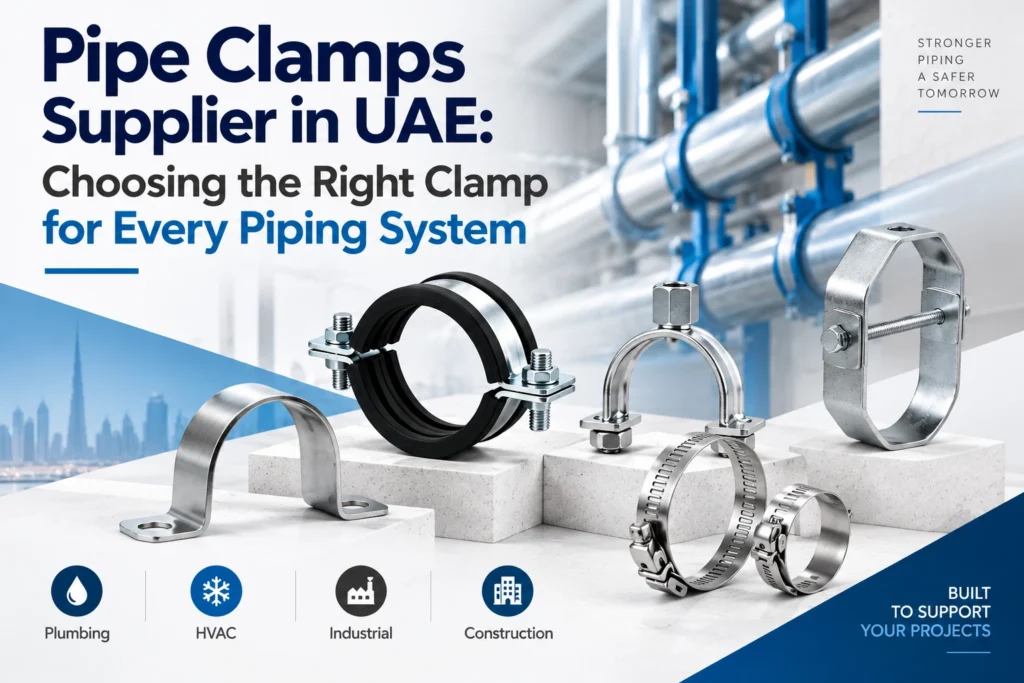
A U clamp is typically a single-piece bent bracket, fixed to a wall or structure with two screws or bolts through flat ends. It’s built for light to medium loads on straight horizontal or vertical runs — think small-bore water supply lines, low-pressure drainage, or conduit. Cheap, fast to install, not meant for anything under significant vibration or thermal movement.
Where a U bolt clamp is the better call
A U bolt clamp is a genuine bolt bent into a U-shape, threaded on both ends, fastened through a separate base plate or bracket with nuts. That threaded design gives it real clamping force — you can torque it down. This is the one you want for heavier pipe, higher pressure lines, or anywhere the pipe might need periodic tightening as it settles or expands.
| U Clamp | U Bolt Clamp | |
|---|---|---|
| Load capacity | Light–medium | Medium–heavy |
| Adjustability | Fixed, minimal | Adjustable via nuts |
| Typical use | Small-bore, low-vibration | Larger pipe, industrial, HVAC mains |
| Install time | Faster | Slightly longer |
If you’re speccing a fire fighting main or a chilled water header, a U clamp is undersized for the job. Full stop.
U Strap Clamp With Rubber Insert — the One Everyone Skips Until Something Rattles
There’s a particular sound facilities teams in Dubai know well — a faint metallic tap, tap, tap coming from a service riser at 2am when the AHU cycles on. Nine times out of ten, that’s a bare metal clamp on a vibrating pipe with nothing between them to absorb the movement.
A U strap clamp with rubber insert solves exactly this. The rubber lining sits between the strap and the pipe surface, absorbing vibration, preventing metal-on-metal wear, and — this part gets missed constantly — breaking the direct contact that causes galvanic corrosion when a steel clamp sits against a copper or stainless pipe. On HVAC and chilled water systems especially, where lines run for years without being touched, that insert is doing more long-term protection work than the clamp material itself.
It costs a little more per unit. It’s rarely the line item anyone questions once they’ve had to chase a rattle complaint through three floors of false ceiling.
Common Mistakes When Sourcing Pipe Clamps in the UAE
Undersizing for insulation thickness is the most frequent one. A clamp spec’d to the bare pipe diameter won’t fit once 25mm or 50mm insulation goes on — and that’s discovered on-site, not in the office.
Ignoring galvanic corrosion is close behind. Pairing a zinc-plated clamp directly against copper pipe, with no insert or isolation, sets up a slow corrosion reaction that can take a year or more to become visible and considerably longer to explain to a client.
And then there’s buying on price per unit rather than price per system. A cheaper clamp that needs replacing at year two, plus labor, plus scaffolding access in a plant room, was never actually cheaper. It just moved the cost to someone else’s budget line.
For projects that need the full support assembly rather than clamps alone, Junaid World’s plumbing hangers and support supplier page for Dubai and the UAE covers the hanger and bracket side of the same system.
Frequently Asked Questions
Q: What’s the difference between a clamp supplier and a clamp distributor in the UAE?
A: In practice, little — most operate as both, importing from manufacturers and holding local stock. The real distinction worth checking is whether they stock ready inventory or order-to-spec, since that changes your lead time significantly.
Q: Can I use a U clamp instead of a U bolt clamp to save cost?
A: Only for light, low-vibration lines. On larger or pressurized pipe, a U clamp typically lacks the clamping force of a threaded U bolt, and undersizing here is a common cause of early failure.
Q: Do rubber insert clamps cost significantly more than standard clamps?
A: The unit cost difference is usually modest — often 15–25% — and it’s generally offset by avoiding corrosion-related replacement and vibration complaints down the line.
Picking a Clamp Supplier Who Stocks the Right Range
The right clamp is rarely the cheapest one on the quote. It’s the one matched to load, material, and vibration exposure for that specific run. A clamps supplier in UAE worth working with will ask about your pipe material and application before quoting a size — not after you’ve already ordered.
If you’re sourcing for an active project, browse current stock at Junaid World’s store and check availability against your BOQ before it holds up your schedule.