
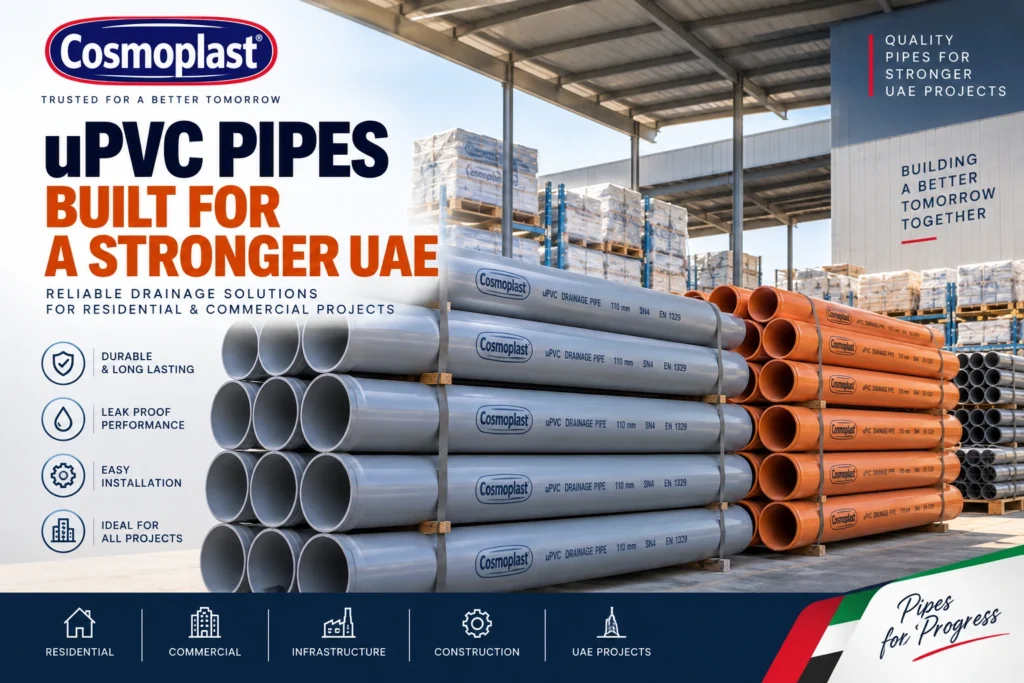
Most uPVC pipe problems on UAE sites don’t start in the trench. They start on the purchase order, where someone wrote “110mm uPVC pipe, 50 lengths” and nothing else.
That line hides three decisions: which standard, which stiffness or pressure class, and which joint. Get any of them wrong and you find out at the pressure test, or worse, two summers later. This guide is for MEP contractors, consultants, developers and villa owners buying Cosmoplast uPVC pipes Dubai Uae and across the UAE. It covers what the range actually includes, how to match a product to an application, how heat changes installation, and what to check before you trust a distributor. The part most suppliers leave out is the fourth section. It’s also the part that causes the most failed joints.
Who makes Cosmoplast uPVC pipes?
Cosmoplast Industrial Co. LLC is a UAE plastics manufacturer headquartered in Sharjah. It is a member of the Harwal Group, and its Pipeline Systems division produces pipes and fittings from 12mm up to 1,200mm in diameter for infrastructure, plumbing, district cooling, irrigation and water extraction. ProTenders
The company has been in the Gulf pipe market since the 1970s. Sources disagree on the exact founding year. Its company profile lists manufacturing facilities in Sharjah, Abu Dhabi and Dubai, and showrooms in Sharjah and Dubai. AEC Online
For a buyer, the practical point is simple: this is local manufacturing. Lead times and batch traceability are usually easier to manage than with imported pipe. That only holds if your supplier actually sources from Cosmoplast, so check it (see below).
Which Cosmoplast uPVC standard fits your application?
Start with the application, not the diameter. Cosmoplast makes uPVC to several different standards, and each one is built for a different job.
| Application | Standard | Class / rating | Typical joint |
|---|---|---|---|
| Soil & waste inside the building | BS EN 1329 | Wall thickness per standard | Solvent weld |
| Underground drainage & sewerage | BS EN 1401-1 | SN2 / SN4 / SN8 | Solvent weld or rubber ring |
| Pressurised cold water, irrigation (metric) | BS EN ISO 1452-2, DIN 8062 | PN6 to PN16 | Solvent weld; rubber ring on larger sizes |
| Pressurised cold water (imperial) | BS 3505 / ASTM D1785 | Class C/D/E; Sch 40/80 | Solvent weld, threaded |
| Electrical & telecom ducts | NEMA TC 2, TC 6 & 8 | EPC-40/80, EB/DB types | Plain end or socket |
Some notes the table can’t carry:
- BS EN 1329 is for above-ground use. It covers soil and waste discharge within the building structure and replaced BS 5255 and BS 4514, with products remaining compatible with the older standards. Cosmoplast
- Underground drainage comes in a wide size range. Cosmoplast’s drainage range runs from 32mm to 1,000mm, with both solvent-weld and push-fit rubber-ring sockets. AEC Online
- Pressure pipe in metric sizes runs from 20mm to 1,200mm with operating pressures up to 16 bar, and in imperial from ½” to 16″. Interplastksa-sales
- BS 3505 classes map directly to pressure. Class C, D and E are rated at 9, 12 and 15 bar working pressure at 20°C.
That last detail matters in the UAE. Every pressure rating is a 20°C number, and nothing in a Dubai villa plant room stays at 20°C.
On stiffness class, my view is that SN2 has little place in UAE villa or commercial work. Once there’s any chance of vehicle loading, soft backfill or a later driveway, SN4 is the practical minimum. The consultant’s specification governs, but where it’s silent, go up a class. The price difference is small compared with digging up a deformed line.
Metric or imperial? Don’t mix them by accident
UAE sites run on both systems, and they don’t fit together. A metric 110mm pipe has a 110mm outside diameter. A 4″ imperial pressure pipe to BS 3505 sits at roughly 114.1mm. Those 4mm are the difference between a sound solvent joint and one that weeps. If a project changes from ASTM Schedule 80 to EN 1452 metric partway through, specify transition adaptors on the drawings.
Solvent welding Cosmoplast uPVC in UAE heat
This is where good pipe fails. Cosmoplast’s own catalogue treats hot weather as a separate case, and it’s worth following closely.
The manufacturer notes that above about 35°C, solvents evaporate faster. It also warns that pipe stored in direct sun runs around 15°C hotter than the air, so the cement attacks the surface faster and deeper. Take an August afternoon in Jebel Ali at 44°C. The pipe surface can be close to 60°C before anyone opens the tin. (Illustrative example based on the manufacturer’s 15°C figure.) cosmoplast
The catalogue’s recommendations are: store cement, cleaner, pipes and fittings in shade; cool the surfaces with a wet cloth and let them dry before cementing; weld in the cooler morning hours; join quickly while the cement is wet; and allow at least 24 hours of cure before pressurising, or 48 hours for sizes above 8″. cosmoplast
That 48-hour figure is the one site programmes ignore. Pressure-testing a 10″ line the next morning to hit a milestone is how you end up testing it twice.
How to vet Cosmoplast distributors in the UAE
Searches for “Cosmoplast distributors in UAE” or “Cosmoplast pipes dealers in Dubai” return plenty of names. Many are stockists or traders, which is fine as long as they are honest about it. Before you place an order with any Cosmoplast supplier or dealer in the UAE, ask for four things.
- A current certificate, not the one in the PDF. Cosmoplast has held BSI Kitemark licences for its drainage and pressure pipe. The copies printed in its 2017 metric catalogue carry dates that have since expired. Ask for the current licence and check it in BSI’s online directory before you put it in a material submittal. cosmoplast
- Stock or order? Ask which sizes and classes sit in their yard today and which get ordered from the factory. This matters most for SN8 and large diameters.
- Mill test certificates and pipe markings (standard, size, class, batch) that match the delivery note.
- Delivery coverage. A Dubai dealer quoting a site in Mussafah should say who pays for transport and how long it takes. If you need a Cosmoplast uPVC pipes supplier in Abu Dhabi, check whether they deliver from Abu Dhabi stock or send trucks from Dubai.
Junaid Sanitary & Electrical Materials Trading supplies plumbing and building-material products for residential, commercial and construction projects across the UAE. The company supports project requirements with Cosmoplast uPVC pipe solutions, including drainage applications and related plumbing requirements.
Coverage: Dubai, Abu Dhabi and Northern Emirates
Applications: Villas, residential buildings, commercial projects, construction and infrastructure.
Common mistakes with uPVC pipes in the UAE
- Ordering by diameter alone. “160mm uPVC” could be a BS EN 1329 soil pipe or an SN8 sewer pipe. They cost differently and perform very differently.
- Using uPVC for hot water. Cosmoplast’s own range uses PPR and PEX for hot and cold water distribution. uPVC is for cold.
- Pressurising before the joints cure. See the 24/48-hour rule above.
- Mixing metric and imperial fittings without adaptors.
- Leaving exposed uPVC unprotected in the sun on roofs and external risers. Ask the supplier what UV protection Cosmoplast recommends for above-ground runs. [VERIFY with manufacturer]
- Submitting expired certificates. Consultants do check, and a rejected submittal costs a week.
Frequently Asked Questions
Q: Where are Cosmoplast uPVC pipes made?
A: Cosmoplast is headquartered in Sharjah. According to its company profile, it has manufacturing facilities in Sharjah, Abu Dhabi and Dubai. That makes it a local manufacturer rather than an importer, which usually helps with lead times and batch traceability on UAE projects.
Q: What standard should I use for underground drainage in Dubai?
A: Underground non-pressure drainage and sewerage in uPVC is normally specified to BS EN 1401-1. Choose the stiffness class (SN2, SN4 or SN8) based on depth, soil and traffic loading. Where the consultant hasn’t stated a class, SN4 is a sensible minimum, and SN8 suits trafficked areas.
Q: Can Cosmoplast uPVC pipe carry hot water?
A: No. uPVC pressure ratings are based on 20°C, and uPVC is intended for cold water. For hot and cold domestic distribution, Cosmoplast makes PPR and PEX systems. Those are the correct choice for villa and apartment hot-water lines.
Q: How long should solvent-welded uPVC joints cure before pressure testing?
A: Cosmoplast recommends at least 24 hours before pressurising. For pipe sizes above 8 inches, it recommends at least 48 hours. In UAE summer conditions, weld early in the morning with shaded, cooled pipe, and don’t shorten the cure time to meet a test date.
Q: Are Cosmoplast uPVC pipes Dubai Uae Municipality approved?
A: Cosmoplast manufactures its uPVC ranges to recognised standards such as BS EN 1401-1, BS EN 1329 and BS EN ISO 1452, and has held BSI Kitemark licences. Approval requirements vary by project and authority, so ask your supplier for current approval letters and certificates, then confirm them with the consultant before submitting.
Before you send the next RFQ
Rewrite the line item. Instead of “110mm uPVC pipe”, write the standard, class, joint type and length, for example “110mm uPVC to BS EN 1401-1, SN4, solvent-weld socket”. Then ask each Cosmoplast supplier for a current certificate and a straight answer on what’s in stock. The quotes you get back will be comparable, and the pipe that arrives on site will match the drawings.