
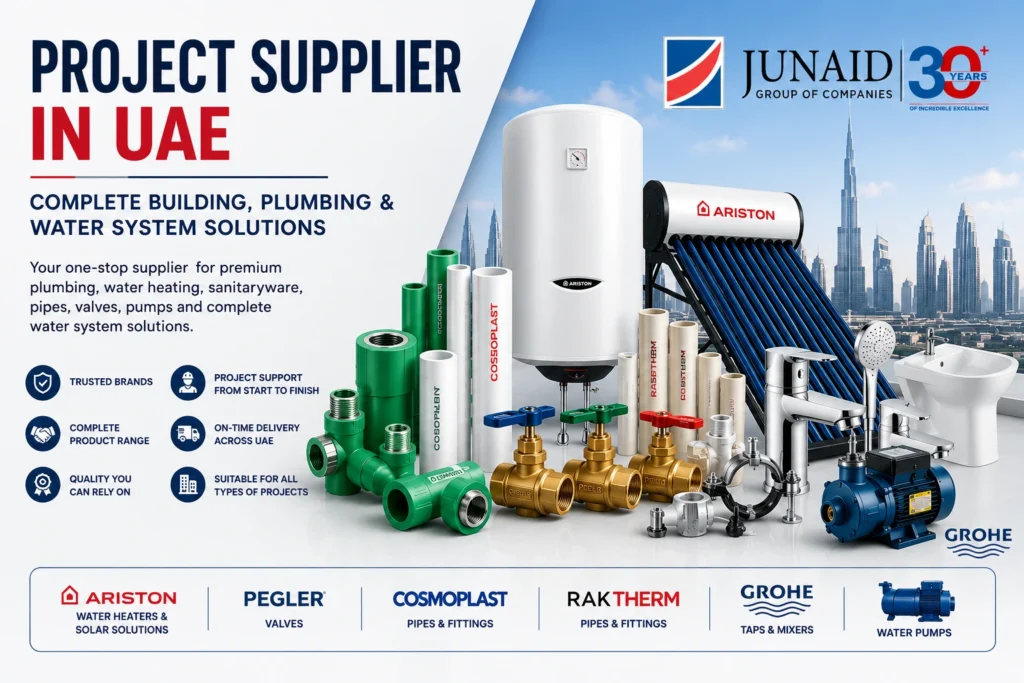
Ask any MEP contractor in Dubai about their worst week on site and you will usually get a sourcing story, not an installation one. Pipes from one trader, fittings from another, a pressure class nobody checked at BOQ stage, and a fusion joint that lets go during hydro test. Preventing that is the real job of a project supplier in UAE. Price per metre is the part everyone compares first. It is almost never the part that costs them.
So this is written from the BOQ side of the table rather than the brochure side: what genuinely belongs under one supply order, what does not, and the specific places where consolidated sourcing stops paying for itself. Some of it argues against buying everything from one place. That is deliberate.
Complete Project Supply Solutions in UAE
A project supplier is not a shop with a delivery van. The difference is scope and sequencing: matching product families across a whole scope of works, holding quantities against a programme, and releasing them in the order the site actually needs them rather than all at once into a compound with no storage.
Three product families cover most of what a plumbing and MEP scope consumes in the UAE.
Plumbing and water systems. PPR, PEX and uPVC pipe with the matching fittings, valves, clamps and supports, plus the sanitaryware and mixers at the tail end of the programme.
Water heating. Electric storage heaters, solar thermal systems, and the storage and distribution pipework that connects them.
Water pumping and pressure. Booster sets, transfer pumps, pressure vessels and the controls that keep the top floor at usable pressure.
The value is in the overlap between those three, not in any one of them. A supplier who quotes the heaters but not the valve tails, or the pipe but not the clamps sized for it, has handed you back the coordination problem you were trying to give away.
Pipes, fittings and the compatibility trap
Pipe and fittings should never be split across brands on the same run. PPR is welded, not threaded: the socket fusion process melts pipe and fitting together at roughly 260°C, so wall thickness tolerance and resin formulation have to match. Two PN20 pipes from two manufacturers can look identical in the store and behave differently in the welder.
Keep the system single-brand from riser to outlet. It costs a little more on some line items. It removes an entire category of site failure.
Plumbing valves
Isolation valves are the cheapest insurance on a building and the first thing value-engineered out of a BOQ. Every riser, every plant room branch, every bathroom group wants isolation. When it is missing, a single failed flexible hose in year three drains a whole floor because the only shutoff is at the tank.
Clamps and pipe support systems
Covered properly further down. Short version: this is the line item that gets substituted most often and causes the most callbacks.
Sanitaryware and bathroom products
Last in, first inspected. Deliveries here need to be timed against handover, not against the pipe order, or you are storing porcelain on an active site for four months.
Ariston Water Heaters and Hot Water Systems
Hot water sizing in the UAE gets treated as an afterthought because the ambient temperature is high nine months of the year. Then January arrives, the incoming main is genuinely cold, and a 50-litre unit serving two bathrooms runs out mid-shower.
Ariston electric water heaters
For residential work, the sizing question is simultaneous demand rather than total occupancy. Two bathrooms used back to back need more storage than four bathrooms used across a whole morning. A rough working rule that has held up well: 50L for a single bathroom, 80–100L for two, and separate units rather than one large tank once the pipe run from heater to furthest outlet passes about 12 metres. Long runs waste both water and the energy already spent heating it.
Commercial installations flip the logic. There you are sizing for peak simultaneous draw and recovery rate, which usually means either a larger storage volume with a higher-kW element or multiple units in series feeding a manifold.
Ariston solar water heaters
Covered in detail in the solar section below, because in Dubai this is a compliance question before it is a product question.
Hot water system solutions
The heater is maybe 60% of the hot water scope. The rest is storage, insulated distribution, expansion control and the safety group. Skipping the expansion vessel on a closed system is common on smaller villa jobs, and it is why the temperature and pressure relief valve on those systems ends up weeping within a year. That is not a faulty valve. That is a valve doing exactly what it was installed to do because nothing else is absorbing the expansion.
Pegler Valves Supplier in UAE
Pegler sits in the specification for a reason that has nothing to do with marketing: consultants trust the pressure ratings and the material certification, so a Pegler line on a BOQ usually clears approval without a substitution submittal. If you are sourcing against an approved vendor list, buying through a Pegler authorised distributor in UAE is what keeps the paperwork clean at handover.
Pegler ball valves
The default for isolation duty. Quarter turn, full bore, minimal pressure drop, and they either work or they visibly do not. For residential work they go on riser bases, bathroom groups and appliance tails. In commercial buildings they take the same role at larger diameters plus plant room isolation.
Ball valves are not throttling valves. Partially opening one to regulate flow wears the seat unevenly and shortens its life considerably. Use them fully open or fully closed.
Pegler gate valves
Still specified widely on water supply mains and larger diameter distribution, mainly where a full-bore straight-through path matters. They are slower to operate and they do not like sitting in one position for years, which is a real consideration in a building where nobody exercises the valves.
Pegler globe valves
This is where you throttle. The seat geometry is designed for partial opening and regulation, which is exactly what a ball valve is not designed for. Higher pressure drop is the trade-off, and on a long commercial run that pressure drop needs to be in the pump calculation rather than discovered afterwards.
Pegler valves for project applications
Valve failures on new projects are overwhelmingly installation failures, not product failures. Overtightened threads, no allowance for pipe movement, thread sealant applied to a face-seal joint. The Pegler valve installation guide covers the torque and orientation points that account for most of them, and it is worth putting in front of a subcontractor before the first fix rather than after the snag list.
Cosmoplast Pipes and Fittings Supplier in UAE
Cosmoplast is the volume choice on a lot of UAE residential and light commercial work, and the range is broad enough to cover a full plumbing and drainage scope from one manufacturer.
| System | Typical use | Working temp | Joining method | Where it struggles |
|---|---|---|---|---|
| PPR | Hot and cold potable supply | Up to 95°C (PN20/PN25) | Socket fusion at ~260°C | Rigid; needs generous expansion allowance |
| PEX | Hot and cold, tight retrofits | Up to 95°C | Press or compression fittings | UV sensitive; needs continuous support |
| uPVC | Cold supply, drainage, irrigation | Ambient only | Solvent cement | Not for hot water, full stop |
PPR is the workhorse for pressurised hot and cold. PEX earns its place where the geometry is awkward: renovations, fit-outs, anywhere you would otherwise need eleven elbows to get from A to B. uPVC handles drainage, cold supply and buried infrastructure and should never see hot water, regardless of what a site fitter tells you about a short run.
On fittings, the rule from the compatibility section applies without exception. PPR fittings match PPR pipe, same brand, same pressure class. Mixing manufacturers to save on a fitting schedule is a false economy that shows up at test pressure.
RAKtherm Pipes and Fittings Supplier in UAE
RAKtherm is manufactured in Ras Al Khaimah, which matters more than it sounds. Lead times on replenishment are days rather than weeks, and when a project needs an extra 200 metres of 32 mm at short notice, local manufacturing is the difference between a two-day delay and a six-week one. For projects running tight programmes, sourcing through a RAKtherm pipes and fittings supplier in UAE removes the import lead time from your critical path entirely.
The technical range mirrors what is described above: PPR for pressurised hot and cold across residential and commercial work, PEX where flexibility is needed, uPVC for supply and drainage, with fittings across all three.
Which to specify between the two brands is usually decided by the consultant’s approved list, availability against your programme, and whether the project is chasing local content credit. Both perform. Anyone telling you there is a dramatic performance gap between them on a standard villa or mid-rise scope is selling something.
Pipe Clamps and Support Solutions
Here is the section that gets skipped, and it is the one worth reading.
Plastic pipe moves. PP-R has a linear expansion coefficient around 0.15 mm per metre per degree Celsius. Run the arithmetic on a real hot water line: 4 metres of PPR going from a 25°C ambient to 70°C flow expands by roughly 27 millimetres. Not a rounding error. Twenty-seven millimetres of movement into a rigidly clamped run with nowhere to go, which is why badly supported PPR develops the distinctive snake-bend sag between clamps, and why the joints at each end start weeping in year two.
The fix is not more clamps. It is the right mix: fixed points that anchor the run and guide clamps that let it slide, with expansion loops or arms where the run is long enough to need them. Glass-fibre reinforced PPR cuts the expansion coefficient by roughly a factor of four, which is a large part of why it is worth the premium on long hot water risers.
Support spacing for plastic is far tighter than for steel, and it tightens further as temperature rises. Follow the manufacturer’s table for the specific pipe, at the actual design temperature, not at ambient.
Three things decide the clamp: pipe outside diameter, pipe material, and the load including the water inside it plus any thermal or seismic movement. Heavy-duty steel clamps with rubber lining go on commercial risers, plant rooms and anywhere the run is carrying weight or vibration. Light plastic clips are for short domestic branches and nothing else.
Five Sourcing Mistakes That Keep Showing Up on UAE Project BOQs
1. Pricing pipe and fittings separately. The cheapest pipe quotation plus the cheapest fitting quotation frequently equals two incompatible systems. Price them as a package from one manufacturer or you have not actually compared anything.
2. No allowance for thermal expansion in the support schedule. Clamps get counted per metre off a drawing with no distinction between fixed and guide points. See above for what that costs.
3. Ordering sanitaryware with the first-fix package. Grohe mixers sitting in a site store for four months get damaged, get stolen, and go out of warranty registration window. Split the delivery against the programme.
4. Sizing pumps from the drawing instead of the building. Static head plus friction loss plus residual pressure at the highest outlet. Undersize it and the top two floors complain forever. Oversize it and you pay for the electricity and the wear.
5. Treating solar water heating as optional on a Dubai villa. It is a permit matter, not a preference. Discovering that at inspection stage is expensive.
Point three is the one I would push hardest on. It is entirely a scheduling decision, it costs nothing to get right, and it causes more disputes at handover than any technical issue on this list.
Sanitaryware and Bathroom Solutions
Grohe sanitaryware
Basins, WCs and accessories in a range that survives specification review on hotel and higher-end residential work. The practical reason Grohe holds its position in the UAE is parts availability: a cartridge that can be replaced in year six rather than requiring a whole mixer swap changes the lifetime cost meaningfully on a building with 300 bathrooms.
Grohe taps and mixers
Basin, kitchen, shower and bath mixers. Two things to check before ordering in quantity for a UAE project: cartridge ceramic quality against local water conditions, and whether the flow rate meets the green building requirement for the emirate the project sits in. Water-efficient fittings are a compliance line item now, not a sustainability nice-to-have.
Complete bathroom solutions
Villas, hotel rooms, commercial washrooms and residential apartments all pull from the same catalogue but at different specification levels and wildly different quantities. Hotel work in particular needs the full set matched: WC, basin, mixer, shower set and accessories from one finish family, ordered together, because a finish variation across a 200-key hotel is not something anyone can unsee.
Solar Water Heating Solutions in UAE
This is where regulation drives the product choice. Dubai Municipality’s green building framework, Al Sa’fat, replaced the older Dubai Green Building Regulations from 19 October 2020, with the Silver Sa’fa level mandatory for all new buildings. Solar water heating requirements sit inside that framework for new villas and buildings where hot water is part of the function. Dubai Municipality’s own figures put the energy saving at Silver level around 19% against baseline.
Verify the current requirement against the live version of the code for your specific plot and building type before you order. The framework has been revised more than once, and requirements differ between emirates.
The physics are firmly on the technology’s side here. Solar irradiation across the UAE runs above 2,200 kWh per square metre annually, which is roughly double what northern Europe sees. A thermosiphon system on a villa roof in Dubai will carry most of the domestic hot water load for most of the year without any electrical input at all.
What actually goes wrong with solar hot water in the UAE
Two things, and neither is the collector.
Stagnation temperature is the first. Summer rooftop conditions above 45°C ambient push an unloaded system to temperatures that cook the fluid and stress the seals. Systems specified for a European climate and dropped onto a Dubai roof fail early in exactly this way. The system needs proper heat dissipation, correctly sized relief and expansion, and over-temperature protection that has been designed for the site rather than assumed.
Scale is the second. Mineral content in the supply builds up inside heat exchangers and storage tanks and quietly strips efficiency year on year. Nobody notices because there is no failure event, just a slowly rising electricity bill as the backup element does more of the work. Descaling belongs in the maintenance schedule from day one.
Solar water heater components
Collector, storage tank, mounting frame, pipework and connections, expansion and relief, plus an electric backup element for the handful of overcast winter days. The backup is not optional in a building where hot water availability is contractual, like a hotel.
Water Pumps for Residential and Commercial Projects
Pump selection is arithmetic, not preference. Total head equals static lift plus friction losses through pipe and fittings plus the residual pressure you want at the worst outlet in the building. Get any one of those three wrong and you find out at commissioning.
For villas and small residential buildings, a single booster pump with a pressure vessel handles it. The pressure vessel is what stops the pump cycling on and off every time somebody opens a tap, and undersizing it is the most common cause of a pump that dies in year two.
Commercial buildings, hotels and larger MEP scopes generally want a multi-pump booster set with duty and standby rotation, variable speed control, and a control panel that alternates lead pump so the wear spreads evenly. In a hotel this is not a refinement. One pump out of service should never mean one building without water.
Note that anything touching the water connection itself runs through the utility. In Dubai, connections, NOCs and network modifications go through DEWA’s builder services, and their requirements sit upstream of whatever you have specified internally. Check them before finalising the pump and meter arrangement, not after.
Project Supply for Different Building Types
| Project type | Where the supply pressure sits | Most common sourcing failure |
|---|---|---|
| Villas | Solar compliance, hot water sizing | Solar treated as optional; heater undersized for simultaneous use |
| Apartment buildings | Riser coordination, isolation valves | No floor-level isolation, so one leak affects the whole stack |
| Hotels | Finish consistency, redundancy | Mixed finish batches; no standby pump |
| Offices and retail | Fit-out programme timing | Materials delivered against the wrong programme phase |
| Renovations and fit-outs | Working around existing services | Rigid pipe specified where PEX would fit the geometry |
New-build work is the straightforward case: quantities are known early, the programme is visible, and supply can be staged against it. Renovation and fit-out are harder to supply because quantities move once the ceilings come down, and a supplier who cannot handle a mid-project variation without a two-week lead time is a genuine risk to your programme.
Why Junaid Works as a Project Supplier in UAE
Being straight about this: any established trader in the UAE can sell you a pipe. What is worth paying for is coordination across a scope.
The brand coverage matters because it removes substitution risk. Ariston for water heating and solar, Pegler for valves, Cosmoplast and RAKtherm for pipes and fittings, Grohe for sanitaryware and mixers. Those are the names that clear consultant approval on most UAE projects without a substitution submittal, and the submittal process is where programme time quietly disappears.
Product breadth under one order is the second piece. Pipes and fittings, valves, clamps and supports, water heaters, solar systems, pumps and sanitaryware from a single point of contact means one BOQ review, one delivery schedule, one person to call when a quantity changes.
And where it does not help: if your project is a single-line order for one product category at high volume, a specialist importer in that category will likely beat a consolidated supplier on unit price. Consolidation pays on mixed scopes with coordination risk. It does not pay on a straight commodity buy of one item. That is worth knowing before you ask for the quotation.
How the Project Supply Process Works
- Share the project requirements. Building type, scope, programme dates, and whether there is a consultant’s approved vendor list to work within.
- Product and quantity selection. Working from the BOQ or drawings, matching product families so pipe, fittings and supports come from compatible systems.
- Quotation and approval. Itemised against the BOQ so it can be compared line by line, with alternates flagged where a specified item has a long lead time.
- Supply, staged to the programme. Not everything at once. First fix, second fix and finishes released as the site can actually receive and store them.
- Delivery and ongoing support. Including the variations, because there are always variations.
Step two is where a supplier earns or loses the job. A quotation that comes back with the pipe priced and the expansion arrangement ignored is a quotation from someone who has not read the drawing.
Frequently Asked Questions About Project Suppliers in UAE
What does a project supplier do in UAE? A project supplier sources and delivers building, plumbing and MEP materials against a project’s BOQ rather than selling individual items over the counter. The work involves matching compatible product systems, holding quantities against the construction programme, and staging deliveries so materials arrive when the site can actually install them.
Does Junaid supply plumbing materials for commercial projects? Yes. Commercial scopes typically cover riser pipework, isolation and control valves, heavy-duty supports, commercial-capacity water heating, booster pump sets and washroom sanitaryware. These are quoted against the BOQ and released in stages against the programme rather than delivered as a single consignment.
Can I source Ariston water heaters for my project? Yes, across residential and commercial capacities plus solar thermal systems. Sizing should be based on simultaneous demand and recovery rate rather than occupant count alone, and long pipe runs from heater to outlet often make two smaller units a better answer than one large one.
Does Junaid supply Pegler valves in UAE? Yes, including ball, gate and globe valves for residential, commercial and MEP applications. Sourcing through an authorised distributor keeps the certification and traceability documentation intact, which matters when the project is being handed over against an approved vendor list.
Can I buy Cosmoplast and RAKtherm pipes for a project? Yes, both brands across PPR, PEX and uPVC with matching fittings. The important rule is that pipe and fittings on the same system should come from the same manufacturer, since fusion welding depends on matched wall thickness and resin formulation between the two.
Does Junaid supply Grohe taps and mixers? Yes, covering basin, kitchen, shower and bath mixers plus sanitaryware and accessories. For hotel and multi-unit residential work, ordering the full finish family together is worth insisting on, because finish variation between production batches is visible and effectively impossible to correct later.
Can you supply solar water heaters for villas? Yes. For Dubai villas this is usually a compliance requirement under the municipality’s green building framework rather than an optional upgrade. Systems should be specified for UAE stagnation temperatures and local water hardness, with over-temperature protection and a descaling plan built into the maintenance schedule.
Do you supply water pumps for commercial buildings? Yes, including multi-pump booster sets with duty and standby rotation for hotels, offices and larger residential buildings. Selection needs total head calculated from static lift, friction loss and required residual pressure at the highest outlet, not estimated from the building height alone.
Can you provide multiple products under one project order? Yes, and that is where consolidated supply is most useful. Mixed scopes covering pipes, valves, supports, heaters, pumps and sanitaryware get one quotation, one delivery schedule and one point of contact. Single-category bulk orders are usually better priced through a category specialist.
Send the BOQ and Start There
If a project is being sourced right now, the fastest useful step is not comparing five quotations on pipe price. It is checking one thing: whether the pipe, the fittings and the support schedule on the current BOQ all belong to the same system, at the same pressure class, with an expansion arrangement someone has actually calculated. That single check catches more programme risk than any amount of unit-price negotiation.
Send through the BOQ or the drawings with the programme dates and the approved vendor list, and the quotation comes back itemised, with any long-lead items flagged before they become a problem instead of after.