
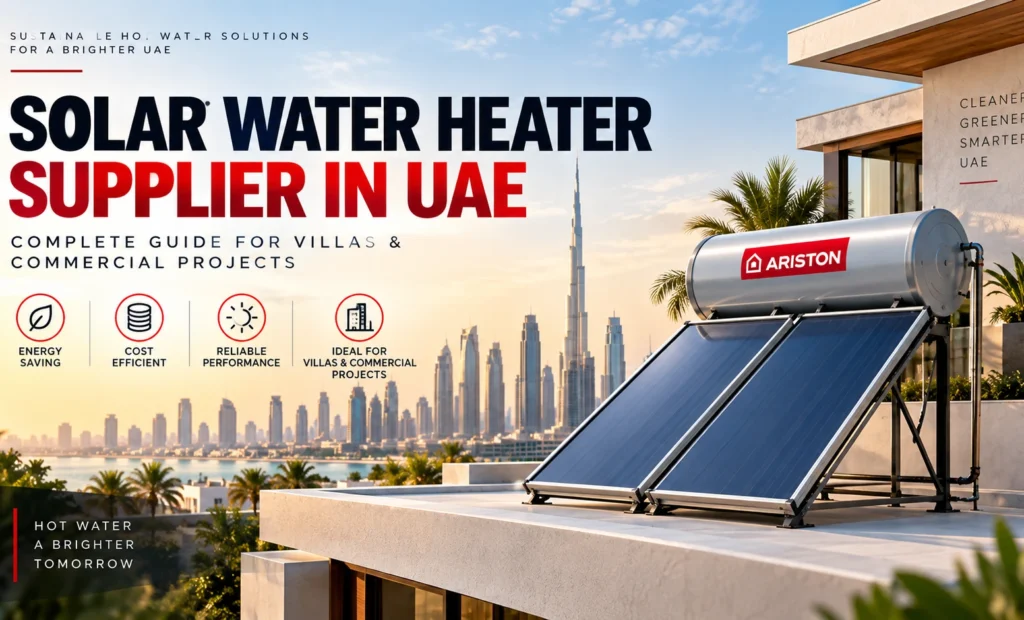
If you’re building a villa or managing a commercial property in the UAE, your water heating costs are probably one of those surprises nobody warns you about. A family of four using hot water for showers, dishwashing, and laundry? That’s running through 40–50 litres of heated water daily. Add Dubai’s heat and DEWA’s green-building requirements—which mandate a 75% domestic hot-water contribution from solar systems in new villas—and the case for solar water heating stops being optional.
Finding the right solar water heater supplier UAE is now a compliance issue, not a luxury choice. DEWA changed that.
Why a Solar Water Heater Supplier in UAE is Non-Negotiable Now
Dubai’s construction regulations shifted this responsibility entirely. New villas and labour accommodations must meet DEWA’s solar water-heating targets. Not optional. Built-in. According to DEWA’s Demand Side Management guidelines, the 75% solar contribution requirement applies to all new residential construction—this is why every solar water heater supplier in UAE now handles compliance documentation as standard.
Here’s what that actually means for your property: a properly sized solar water heater can cover three-quarters of your annual hot water demand without touching the grid. In summer, that number climbs toward 90%. Winter? Still 60–70%. The math isn’t theoretical—it’s been mandated by regulators because it works.
Residential buildings face the same requirement. Hotels save roughly 30–40% on water heating energy costs. Labour accommodation blocks (common in Abu Dhabi and Jebel Ali industrial zones) reduce operating expenses by a measurable margin. Commercial buildings in office parks and restaurant chains see the payback in three to four years.
The reason this matters: you need a supplier who understands the local regulations, the specific hot-water demands of different building types, and how to size a system that actually delivers on those DEWA targets.
The Components You Need to Understand Before Choosing a Solar Water Heater Supplier
A solar water heating system isn’t complicated, but every component has to work together correctly. This is critical knowledge when evaluating any solar water heater supplier in UAE—they should be able to explain how each component performs in desert conditions.
Solar collectors sit on your roof and absorb heat from sunlight. You’ll typically see flat-plate collectors in UAE installations—they’re robust, affordable, and don’t need maintenance every month. The size depends on roof space and your daily hot-water needs. A 100-litre daily requirement needs roughly 2–3 square metres of collector area. A villa with multiple bathrooms and a guest house? You’re looking at 4–6 square metres. According to Solar Energy International standards, collector sizing in hot climates requires higher precision than temperate regions.
Storage tanks hold the heated water and keep it hot overnight. This is where insulation matters enormously. A poorly insulated tank loses 10–15 degrees in a few hours. A well-insulated one holds that temperature for 18–24 hours. Tank capacity ranges from 100 litres for small villas to 300–500 litres for family homes or small commercial applications.
Circulation components—pipes, pumps, valves, and controllers—make the system move water efficiently from collectors to storage to your taps. In thermosyphon systems (the most common type), hot water rises naturally without pumps. In larger buildings or where roof placement is awkward, forced-circulation systems use small electric pumps controlled by temperature sensors.
Backup heating kicks in on cloudy days or during peak demand. Most installations use electric heating elements in the storage tank. A few properties use gas backup, but electric is standard in UAE villas because gas infrastructure isn’t available everywhere.
Sizing: The Step Nobody Gets Right Without a Solar Water Heater Supplier
Walk into any property and ask the owner how much hot water they actually need daily. Most guess wrong. The gap between guessing and knowing is where solar systems fail—and where a qualified solar water heater supplier in UAE makes the difference.
A typical villa with 3–4 bathrooms needs 150–200 litres of hot water per day. That’s 3–4 square metres of solar collectors and a 200-litre insulated tank. Double the bathrooms, add a guest house, or run a small guest villa operation? You’re at 300–400 litres daily. Real-world consumption data shows villas often underestimate by 30%, which is why any solar water heater supplier worth engaging will conduct a detailed usage audit. Energy efficiency studies from Middle Eastern building councils confirm that undersized systems fail to meet occupant expectations.
Hotels calculate differently. They need peak-demand availability—every guest taking a hot shower simultaneously—plus storage for continuous supply. A 100-room hotel might need 10–15 square metres of collector area and 1,000+ litres of storage to maintain water temperature during peak morning hours without electric backup.
Residential buildings (apartments) share hot water systems, which means the total demand concentrates in 2–3 hours. A 200-unit building doesn’t need the sum of 200 individual systems. Shared infrastructure cuts the collector area by 30–40%.
This is where working with a proper solar water heater supplier matters. They’ll ask about occupancy patterns, number of bathrooms, shower duration, laundry frequency—the actual behaviour of the building, not just unit count.
The System That Works Best: Ariston Thermosyphon in UAE
Ariston thermosyphon systems have become the standard choice across UAE villas and smaller commercial properties. The reason is straightforward: they’re reliable, require almost no maintenance, and they work without fancy electronics.
A thermosyphon system uses basic physics. Solar collectors heat water. Hot water is less dense than cold water. It rises naturally into the storage tank mounted above. Cold water sinks back down to the collectors. This circulation happens automatically, 24/7, without pumps or sensors failing.
You can read more about Ariston solar water heater specifications and installation approaches to understand the exact models available for your project size.
The tradeoff: thermosyphon systems need the storage tank positioned above the collectors. That limits placement flexibility. On some villas with awkward roof shapes, you might need a forced-circulation system instead.
Ariston’s thermosyphon range includes models from 100 to 300 litres, with collector options from 2 to 6 square metres. That covers 95% of residential applications in Dubai and Abu Dhabi.
Installation: Where a Solar Water Heater Supplier Determines Success or Failure
The best solar water heater supplier in UAE doesn’t just deliver equipment. They nail the installation—because installation quality directly determines whether your system hits DEWA targets or falls short.
Roof assessment first. A structural engineer checks that your roof can safely carry the collector weight (roughly 20–25 kg per square metre) and the tank weight (200–400 kg depending on capacity). This isn’t optional—it’s about liability and safety. Leading solar water heater suppliers conduct these assessments before quoting.
Orientation and angle matter massively. Solar collectors face south (in the Northern Hemisphere) at a tilt angle matching your latitude. Dubai’s 25 degrees north means roughly 30 degrees tilt. A collector facing east or west loses 15–25% efficiency. Pointing straight up? You lose 40%. IRENA’s solar installation guidelines for MENA countries document these performance penalties in detail.
Piping and connections need proper insulation immediately. Hot water cooling in uninsulated pipes is like leaving your air conditioning compressor outside. By the time it reaches the tap, you’ve lost 8–10 degrees. A first-floor guest bathroom waiting for hot water to arrive is a daily annoyance.
Testing and commissioning involves pressurizing the system, checking for leaks, measuring water temperature at various points, and confirming the backup heating kicks in correctly. This takes half a day. Rushing it means finding problems two weeks into operation when contractors have already left.
Commercial Projects and Bulk Supply
For hotels, residential complexes, and labour accommodation, you need a supplier who understands BOQ-based supply and project coordination.
That means:
- Calculating exact tonnage of collectors and tanks
- Coordinating delivery timing with construction schedules
- Matching equipment specifications to MEP (mechanical, electrical, plumbing) design documents
- Handling multiple unit installations with consistent quality
- Providing warranty support across dozens or hundreds of installations
Learn about commercial solar water heater supply options and project management approaches to see how integrated suppliers handle scaling beyond individual villas.
The Maintenance Nobody Wants to Talk About
Solar water heating systems need almost no maintenance. Almost.
Dust and sand in Dubai do accumulate on collectors. Every 6–12 months, rinse them with fresh water. That’s it. Valves, pipes, and tank connections should be checked annually for small leaks or corrosion. Electric backup heating elements last 5–7 years before needing replacement. The thermostat and temperature sensors rarely fail, but when they do, replacement takes a single service call.
This low-maintenance reality is precisely why thermosyphon systems win in UAE properties. No pumps failing. No controllers needing reprogramming. No firmware updates. Just physics and plumbing working silently.
Frequently Asked Questions About Solar Water Heater Suppliers in UAE
Q: How much does a solar water heater system cost in UAE? A: Residential villa systems (150–200 litres) range from AED 4,000–7,000 installed. Commercial systems vary by size and complexity. Get quotes from multiple solar water heater suppliers in UAE—costs include collectors, tank, installation, and testing. Payback period is typically 4–5 years through energy savings.
Q: Does DEWA require solar water heaters on new villas? A: Yes. DEWA mandates 75% of domestic hot water come from solar systems in new villas and labour accommodations. This applies to all new construction permits issued after 2014. Your solar water heater supplier in UAE must provide DEWA-compliant documentation and certification before handover.
Q: What size solar water heater do I need for a 4-bedroom villa? A: A typical 4-bedroom villa needs 150–200 litres daily capacity, requiring 3–4 square metres of collectors and a 200-litre storage tank. Any experienced solar water heater supplier will conduct a site assessment and usage audit before recommending exact specifications. Oversizing is common but expensive.
Q: Can a solar water heater work in winter in UAE? A: Absolutely. Even in winter, solar collectors deliver 60–70% of hot water demand on cloudy days. The system includes electric backup heating for peak winter demand. A proper solar water heater supplier sizes backup capacity for worst-case scenarios.
Q: How long do solar water heater systems last? A: Properly installed systems last 15–20 years. Collectors are typically warrantied for 10 years, storage tanks for 5–7 years. Choose a solar water heater supplier offering extended warranty and spare parts availability to ensure long-term reliability in UAE’s hot climate.
Q: Is roof space a limiting factor for solar collectors? A: Most villas have sufficient roof space. A 200-litre system needs 3–4 square metres. If space is tight, your solar water heater supplier can recommend high-efficiency collectors or forced-circulation systems with flexible tank placement to maximize available area.
Q: What maintenance do solar water heaters require UAE? A: Minimal. Rinse collectors every 6–12 months to remove dust and sand. Inspect connections and valves annually. Electric backup elements last 5–7 years. Working with an experienced solar water heater supplier UAE ensures they include maintenance guidance and spare parts availability.
Q: Can I add solar water heating to an existing villa? A: Yes. Retrofitting is possible but requires roof assessment and structural reinforcement checks. Existing plumbing can usually integrate with new solar systems. A solar water heater supplier specializing in retrofits will evaluate your villa’s compatibility before quoting.
Finding the Right Supplier Isn’t a Price Conversation
You need someone who’ll ask about occupancy patterns, building orientation, local building codes, and your actual hot-water consumption before mentioning equipment costs.
A solar water heater UAE who leads with price is signalling that they’re treating this like a commodity. It isn’t. A system sized 20% too small is misery. Installed with poor orientation, it’s waste. Piped without insulation, it’s frustration.
The right supplier brings design expertise, understands DEWA requirements, coordinates with your MEP engineer, handles installation directly or supervises contractors carefully, and stands behind the system for years.
That’s the foundation. Everything else—price, warranty terms, spare parts availability—makes sense once you’ve got the right technical fit.