
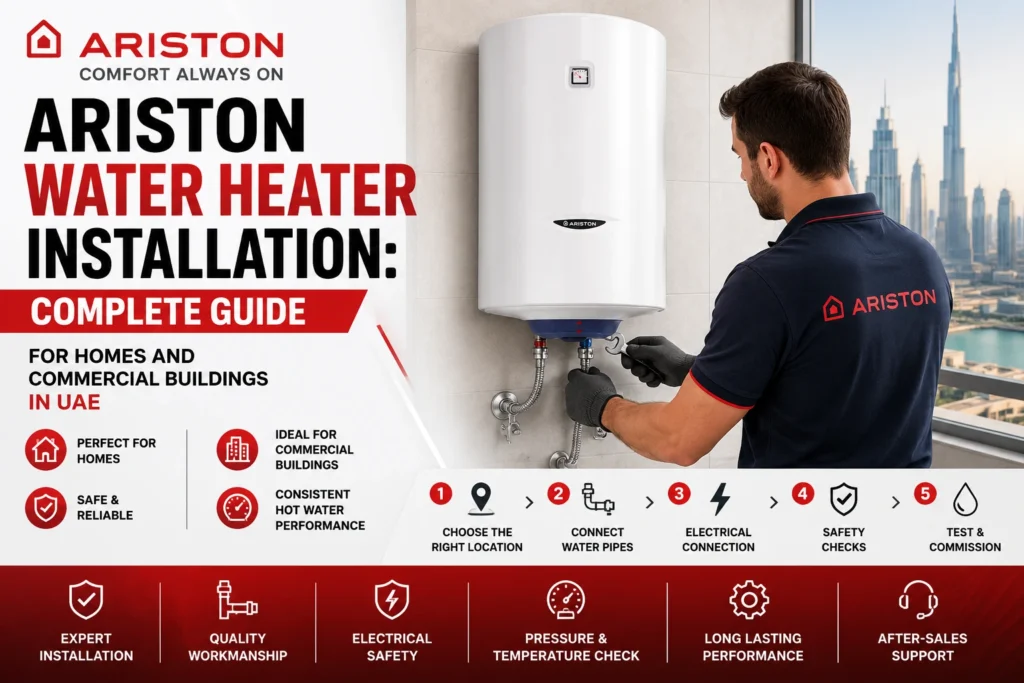
A water heater almost never fails on the day it’s fitted. It fails eight months later, at 6am, usually into a ceiling above somebody else’s bedroom. And when the unit finally gets opened up, the cause is boringly consistent: a safety valve that was never fitted, a bracket sunk into hollow block, or mains pressure nobody measured.
Ariston water heater installation in the UAE isn’t complicated work. It’s unforgiving work. The gap between a unit that runs quietly for a decade and one that floods a flat comes down to about four decisions, and all four get made in the first two hours.
Before You Install: Capacity, Location, Pressure
Here’s what nobody tells you about sizing in the Gulf. In July your rooftop tank sits at 45°C, so incoming water is already near shower temperature and the heater barely works. In January that inlet drops to roughly 20–22°C and the heater does real work for the first time all year.
So people buy in summer, think it’s fine, then run out of hot water halfway through the second shower in December.
Size for January. Not for the day you’re standing in the shop.
| Capacity | Suits | Filled weight |
|---|---|---|
| 50 L | Studio or 1-bath apartment, 1–2 people | ~65 kg |
| 80 L | 2–3 people, two bathrooms | ~95 kg |
| 100 L | 4+ people, or any home with a bathtub used regularly | ~115 kg |
Bathtubs change the maths completely. Filling a standard tub takes 60–80 litres of blended water, which drains a 50 L tank and most of your patience.
But I’d push back on the reflex to jump straight to 100 L “to be safe.” A bigger tank means bigger standing loss, and in a UAE apartment that heat goes into air you’re paying to cool. Twice. Two people in a two-bathroom flat who never take baths should buy 80 L. You can compare capacities and current pricing across the Ariston water heater range in Dubai before committing.
Location. Plenty of UAE partition walls are hollow block or gypsum. They look solid; they aren’t. Knock first. If it sounds like a drum, drill a pilot hole before you commit. Leave 500 mm clear at the electrical cover and enough room below to withdraw the heating element, because a 300 mm access hatch turns every future service call into a demolition job.
Pressure. Measure it. A gauge on a hose bib costs almost nothing. Ariston storage heaters carry a safety valve rated around 8 bar, and UAE supply usually lands between 2 and 6 bar, but pumped high-rise systems spike well past that on lower floors. Above 5 bar at the inlet, you need a pressure reducing valve set to 3–4 bar.
Clearances vary between horizontal and vertical models; the technical sheets on Ariston’s Middle East site list them per unit.
The Installation Process: 6 Steps
Order matters more than any individual step. The most expensive error on this list is doing step 6 before step 5.
1. Mark and check the position. Hold the template up, mark both fixings, then check what’s behind the wall. Concealed conduit in most UAE apartments runs about 300 mm below ceiling level, which is exactly where you’re about to drill.
2. Mount the unit. Rate the fixings for three times the filled weight, so roughly 350 kg for a 100 L heater. Generic plastic wall plugs are not adequate above 50 L. Use chemical anchors into solid substrate, then level the body on both axes before tightening fully. A vertical unit tilted forward pushes the air pocket away from the top of the tank and can leave the element partially uncovered.
3. Connect the pipes. Blue collar to cold, red to hot. The cold inlet feeds a dip tube that delivers incoming water to the bottom of the tank, preserving the hot layer at the top. Cross the connections and you dump cold water straight into the hot zone; the heater still works, it just performs like a unit half its size. On the cold inlet, fit the temperature and pressure relief valve, then an isolation valve. The T&P valve costs about AED 30 and the customer can’t see it, which is exactly why cheap installations skip it. It’s the component that stops your tank becoming a pressure vessel.
4. Wire it. Dedicated circuit from the distribution board, 20 A double pole isolator with neon indicator, mounted outside the shower zone. Not a 13 A plug into a bathroom socket.
5. Fill before you switch on. Power stays off. Open the cold inlet fully, open a hot tap somewhere in the property, and leave it running until the stream is steady with no air spitting. While that happens, walk every joint with a dry tissue. A dry element burns out in seconds, and it isn’t a warranty claim.
6. Test. Energise, set the thermostat to 55–60°C, and measure the delivered temperature at the tap rather than trusting the dial. Then come back after the first full heat cycle and check the joints again. Thermal expansion opens joints that looked perfect cold, which is why leaks often appear three hours after the installer left.
Electrical Safety and DEWA Requirements
Plumbing errors ruin a ceiling. Electrical errors on a water heater kill people.
DEWA’s Regulations for Electrical Installations put water heaters under household appliances in Section 4.6, requiring a double pole control switch with neon indicator rated for the appliance capacity, with the final connection made from a flex outlet plate adjacent to the heater. Supply is 230 V ±10%, 50 Hz, and every consumer installation must have its own earthing system with earth continuity conductors on each outgoing circuit. The full document is available through DEWA.
In practice that means: dedicated circuit, 30 mA RCD, tested earth continuity before commissioning. In older buildings, verify the building earth is actually intact rather than assuming a socket tester proves it. There is nothing between a failed element and the water in your shower except that earth path.
8 Mistakes That Cause Leaks and Failures
- Sizing from summer performance. Fine in August, disappointing in January.
- Reversed inlet and outlet. Looks like an undersized heater, gets misdiagnosed as one, and the “fix” is selling a bigger unit that does the same thing.
- No T&P valve, or a plugged discharge. Someone gets tired of the dripping and caps the pipe, removing the only pressure relief in the system. This is how tanks rupture. Dripping usually means inlet pressure is too high, not that the valve is faulty.
- Fixings sized for the empty weight. An 80 L unit is 25 kg in the box and 95 kg on the wall.
- Switching on before the tank is full. Element gone in under 30 seconds.
- Never measuring inlet pressure. Two minutes and a gauge.
- A 13 A plug into a bathroom socket. Fails DEWA requirements, common in villa retrofits.
- No thought for the next technician. Sealed into a shaft nobody can work in.
Commercial and Villa Installations
Commercial demand isn’t a capacity question, it’s a simultaneity question. A 40-room hotel doesn’t need 40 showers of storage; it needs to cover the 45-minute overlap between 6:30 and 7:30am. Multiple mid-size units in parallel, individually isolated, beat one large central tank, because a fault in one shouldn’t take a floor offline.
Same logic in villas. If any hot run exceeds about 15 metres, a second heater near that zone will outperform a bigger central tank. Sourcing matched units from the same Ariston water heater suppliers in the UAE keeps spares and service intervals aligned across the property, which matters more than it sounds by year five.
Frequently Asked Questions
How much does Ariston water heater installation cost in UAE? Like-for-like replacement typically runs AED 250–500 for labour on top of the heater. New installations needing fresh pipework or a dedicated circuit generally land between AED 600 and AED 1,500, varying by emirate and by whether building management requires an approved contractor.
Can I install an Ariston Water Heater Installation UAE myself? The plumbing, technically. The electrical work, no: fixed wiring falls under DEWA regulations and needs a licensed contractor, and most managed buildings prohibit unapproved installations outright. DIY also voids the warranty on most units sold here.
What size Ariston water heater do I need? 50 L for one to two people with a single bathroom, 80 L for two to three people or two bathrooms, 100 L for four or more people or any home with a regularly used bathtub. Size against the winter inlet temperature.
Why does an Ariston water heater leak after installation? Usually over-tightened or under-sealed threads, thermal expansion opening a joint that was fine cold, or the T&P valve discharging because inlet pressure is too high. That last one isn’t a fault. Fit a pressure reducing valve.
How often should an Ariston water heater be serviced? Annually for residential, twice yearly for commercial. Include a tank flush, element inspection, T&P valve test, and an anode rod check. In UAE water that sacrificial anode can be substantially consumed inside 18 months, and replacing it costs a fraction of replacing a tank.
What Actually Determines Whether Your Installation Lasts
Reliable Ariston water heater installation in the UAE is a chain: capacity sized for January, a wall that carries the filled weight, a T&P valve with visible discharge, an earthed circuit with RCD protection, a full tank before power, and a second leak check after the first heat cycle. Break one link and the unit still runs. It just fails earlier, at a worse time.
Cheapest useful thing you can do this week: put a gauge on a tap and find out what your inlet pressure actually is. That one number decides whether you need a PRV, and it quietly determines how long everything downstream survives.